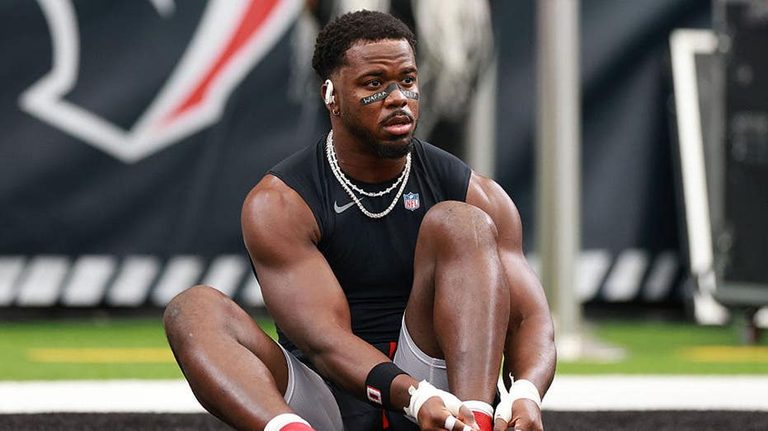
Houston, Texas – In Week 2 against the Cincinnati Bengals, Texans linebacker Azeez Al‑Shaair appeared on the field without the pro‑Palestinian eyeblack he had tried to wear during warm‑ups. The change came after an NFL official warned the team that the player would be removed from the game if the message remained.
Background on the fines
Al‑Shaair, who is Muslim, first attracted league discipline in Week 1 when he inscribed the name of Hind Rajab, a teenage girl killed in Gaza, on his eyeblack. The league fined him $11,492, citing its rule that prohibits personal messages on player equipment during game day.
Undeterred, the linebacker returned for the next week’s game with the name of another Palestinian girl, Wafaa Akila, painted on his eyeblack. The inscription stayed on his face as the game began, but an NFL official spotted it and immediately informed the Texans and Al‑Shaair that the league would not allow him to play with the message.
Compliance and contract details
Faced with the prospect of being removed from the contest, Al‑Shaair chose to remove the eyeblack and completed the entire game without further incident. The player’s decision underscores the league’s longstanding policy that limits personal messaging to preserve a uniform appearance on the field.
Al‑Shaair recently signed a three‑year contract extension worth $54 million, indicating the team’s confidence in his on‑field contributions despite the controversy surrounding his off‑field statements.
League policy and precedent
The NFL’s stance on personal messages is not new. The league has repeatedly warned players that any individualized markings—whether on helmets, cleats, or eyeblack—must be removed or the player will be barred from participation. Historical examples include Chicago Bears quarterback Jim McMahon, who was told to forgo a headband with a message before Super Bowl XX, and recent cases involving players such as Maxx Crosby, Odell Beckham and A.J. Brown, who were asked to change personalized cleats.
In January, Al‑Shaair was also fined $11,593 for displaying the slogan “Stop the Genocide” on his eyeblack. The consistency of these actions demonstrates the league’s commitment to a uniform visual standard, which officials describe as preventing a “wild west” of individualized statements on the field.
Public reaction and broader context
Al‑Shaair’s remarks have sparked debate among fans and commentators. While he emphasizes the humanitarian aspect of highlighting the death of a Palestinian child, critics note that the conflict also involves civilian casualties on the Israeli side and the use of children by Hamas as shields. The NFL’s neutral enforcement of its equipment policy sidesteps the political dimensions of the issue, focusing instead on maintaining a consistent appearance for all teams.
As the Texans prepare to travel to Indianapolis for their next matchup, the league’s message is clear: personal political statements on player equipment will not be tolerated, regardless of the cause being championed.
Original reporting: Fox News (HLL/CB) — read the source article.