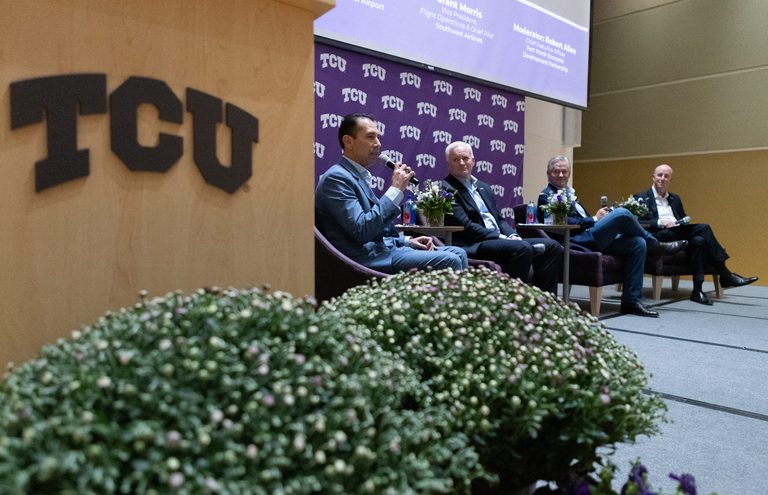
Fort Worth’s status as a national aerospace hub received a boost on Oct. 27 when Texas Christian University (TCU) announced a new professional aviation degree. The ceremony, attended by leaders from American Airlines, Southwest Airlines and Dallas Fort Worth International Airport, highlighted the program’s focus on preparing students for leadership roles in airlines, airports and related organizations.
Program details and local impact
Offered through TCU’s College of Education, the bachelor’s degree includes a minor in aviation studies and a concentration in aviation administration. A professional‑pilot track is slated to begin in fall 2027. Coursework covers aviation safety, airport operations, decision‑making and the physics of flight, giving students a broad foundation for careers ranging from airport management to airline operations.
TCU provost Floyd Wormley Jr. emphasized the university’s unique position: “It also gives TCU an opportunity to best educate the talented professionals who will lead this industry to the next level – in a way that nobody does like TCU.” The program leverages Fort Worth’s proximity to major carriers and DFW Airport, providing students with direct access to industry expertise and potential internships.
Industry leaders stress people‑first approach
American Airlines CEO Robert Isom described aviation as a “people‑serving‑people business,” noting that the airline’s DFW hub supports roughly $70 billion in annual economic output and 350,000 jobs across North Texas. He added that American serves about 700,000 customers daily, underscoring the scale of the workforce needed.
Southwest’s vice president of flight operations, Grant Morris, said employers seek curious, motivated individuals who can creatively analyze data to improve safety and efficiency. “I encourage our team to ask questions all the time, even if you think you know the answer,” he told the graduating students.
DFW Airport CEO Chris McLaughlin highlighted the airport’s push to use artificial intelligence for heating, cooling and maintenance, noting a looming shortage of skilled tradespeople. He plans to build an internal team of data scientists and engineers to keep the airport running smoothly.
Student perspective
Anastasia Kalulika, a TCU aviation student originally from the Congo and raised in South Africa, shared how the program opened new career possibilities. After a childhood dream of becoming a flight attendant shifted, she now aims for airport management and is considering a business minor. “I know now I have more options than just a flight attendant,” she said.
Why the program matters for Fort Worth
The new degree aligns with the region’s economic goals. By cultivating a pipeline of technically skilled, people‑focused professionals, TCU helps address the labor shortages that airlines and airports face nationwide. The initiative also reinforces Fort Worth’s reputation as a leading aerospace center, attracting further investment and job growth.
Local officials and business leaders praised the collaboration, calling it a model of how higher‑education institutions can directly support community prosperity. As the aviation sector continues to expand, the partnership between TCU and industry partners promises to keep North Texas at the forefront of the global aerospace market.
Original reporting: Fort Worth Report — read the source article.