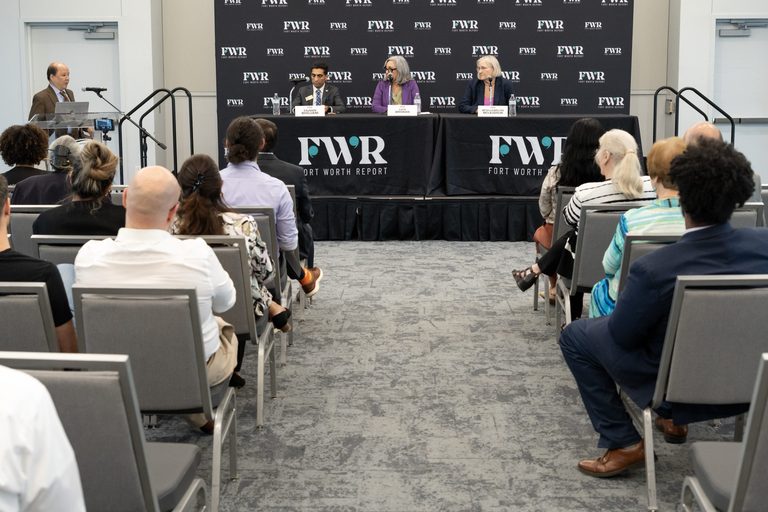
Five candidates seeking seats in the Texas House gathered Thursday evening at Texas Wesleyan University for a forum hosted by the Fort Worth Report, KERA and the League of Women Voters of Tarrant County. The candidates—representing Districts 92, 93, 94, 97 and 98—focused on three issues that affect everyday life in the county: property‑tax relief, public‑school funding and responsible development of data centers.
Tax relief and school funding
All five agreed that residents need relief from rising property taxes. Governor Greg Abbott’s proposals to cap local government spending, let voters approve tax‑rate increases, limit appraisal growth and eliminate the school homestead tax were described by three candidates—Bhojani, Llewellyn McLaughlin and Brennan—as a “nonstarter.” They argued that the state should instead reprioritize existing revenue streams to fund essential services and education.
Former Fort Worth ISD teacher Llewellyn McLaughlin said Texas has the wealth to fund programs that help families, but the current priorities are misplaced. She called for the repeal of the state’s school voucher program, insisting that public money should stay in public schools.
Both Bhojani and Brennan echoed that sentiment, supporting the end of the voucher program and urging the reduction or elimination of tax abatements for corporations. Bhojani, who immigrated from Pakistan as a teenager and worked in gas stations for $6 an hour, said, “I’m trying to give back to the community that made me successful, but the American dream is too hard to achieve for many because of the affordability crisis.”
O’Brien Duzan emphasized “sustainable and pragmatic” tax relief that would not force cuts to city programs. Meanwhile, Bean highlighted that many taxing entities in District 94 have managed their budgets responsibly and should not be penalized by sweeping state mandates.
Data‑center regulation and local oversight
All candidates agreed the Legislature must adopt statewide regulations for the rapidly expanding data‑center industry while preserving local control. Brennan, whose district includes a proposed data‑center project near Keller and Westlake, called for local authority over siting decisions and state rules to protect water and power supplies.
“We need some regional structure to oversee these boundaries so that one city is not dumping on another city,” Brennan said.
O’Brien Duzan and Bean noted that data centers are unlikely to encroach on District 94, which has little undeveloped land, but both supported safeguards to protect resource supplies and keep facilities away from homes. Bean described existing centers as “an eyesore” and “a sound‑sore,” urging restrictions to protect property values.
Housing affordability and Senate Bill 840
Bean and O’Brien Duzan also discussed Senate Bill 840, a 2025 law that allows developers to build multifamily and mixed‑use housing on non‑residential commercial sites. While the law aims to increase housing supply, the candidates said it strips local control from cities such as Arlington, forcing them to grapple with unplanned development.
“We’re seeing the unintended consequences play out, especially in Arlington and Grand Prairie,” O’Brien Duzan warned. “Our cities need the ability to plan responsibly for growth.” Bean, who believes Arlington already has a surplus of affordable housing, has drafted legislation to exempt Arlington from SB 840.
Other details
Texas House members earn $7,200 per year plus daily allowances during the legislative session and serve two‑year terms. The forum concluded with a distribution of the Fort Worth Report’s Tarrant County Voter Guide and a Q&A session where candidates answered questions from the audience.
Original reporting: Fort Worth Report — read the source article.