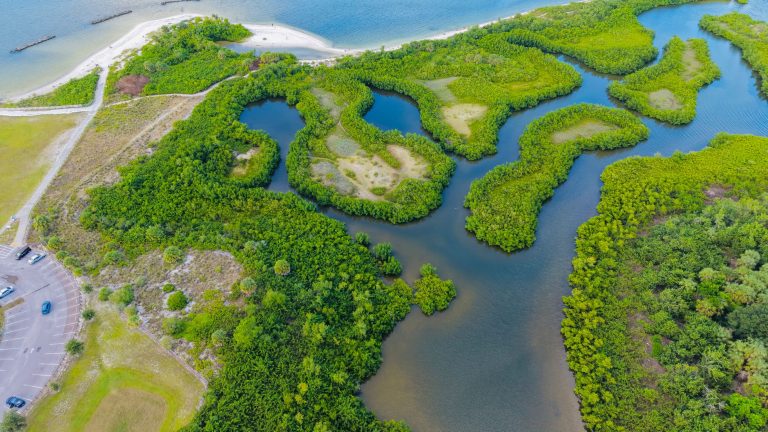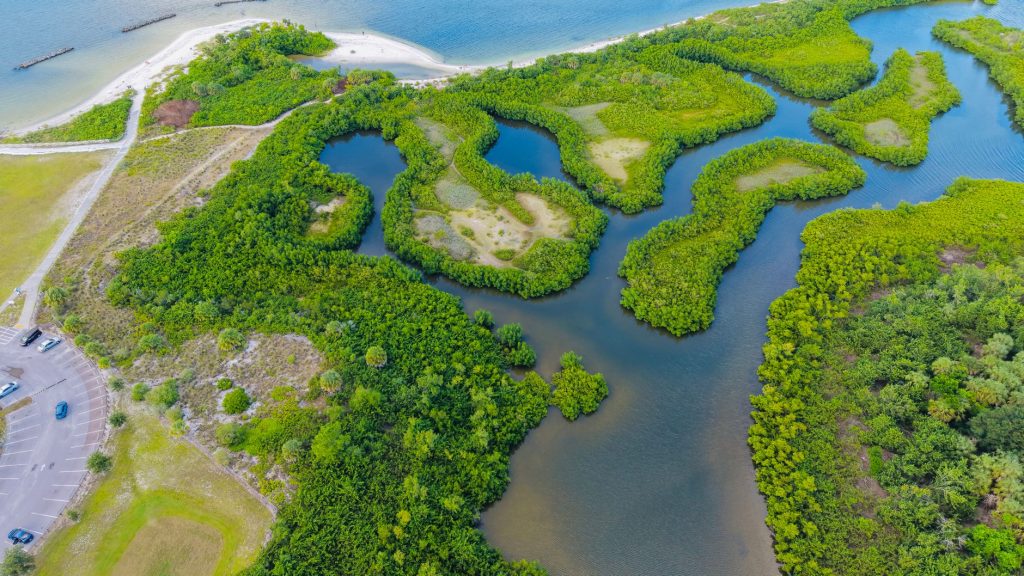
John Cheyney Park sits at the edge of Spring Bayou in Tarpon Springs, a freshwater inlet that most visitors drive past on their way to the sponge docks. That’s their loss. The park is small — a few acres of old live oaks, a fishing pier, a boat ramp — but the bayou itself is something else: glassy and dark green, ringed with grand Victorian-era homes, and almost always calm enough to reflect the treeline back at you in near-perfect detail.
Tarpon Springs built its identity around the Greek sponge divers who arrived in the early 1900s, and that story gets told loudly a few blocks west at the docks. Spring Bayou tells a quieter version. The surrounding Safford Avenue neighborhood is one of the oldest residential streets in town, lined with two-story wood-frame houses dating to the 1880s and 1890s. Some have been meticulously restored; a few still show their age in the paint and the porch planks. Walking the perimeter of the bayou — maybe half a mile around — puts you past a handful of these houses and through a kind of Tarpon Springs that most day-trippers never see.
The park itself has a fishing pier that juts out over the bayou, and local anglers use it regularly. The water holds bass, snook, and the occasional mullet explosion near the surface at dusk. There’s a boat ramp too, modest and functional, used mostly by residents with small skiffs. A covered pavilion near the water is available for gatherings, though on weekday mornings it’s usually empty except for the occasional retiree eating breakfast from a takeout container and watching the egrets work the shallows.
One Saturday each January, the park becomes the center of the Epiphany celebration — the Greek Orthodox Feast of Epiphany, which Tarpon Springs marks with a ceremony that draws thousands. Young men dive into Spring Bayou to retrieve a cross thrown by the bishop; whoever surfaces with it is said to receive a year of good luck. It’s genuinely dramatic, and the crowd that fills the park for it is unlike anything the town sees the rest of the year. But on any other Saturday, the park is relaxed and largely local.
Admission is free, parking is on the street, and there’s nothing to buy. The closest good food is a short walk to Hellas — except that’s on the exclusions list — so better to grab something from one of the dockside bakeries on Dodecanese Boulevard and eat it at the picnic tables under the oaks. The shade there is reliable even in July, which in Tarpon Springs is saying something.
What makes the bayou worth the stop is partly the light, which hits differently on the water here than at the Gulf beaches nearby, and partly the stillness. Tarpon Springs has figured out how to be a tourist town without completely losing its residential character, and Spring Bayou is where that balance is most visible. The pelicans don’t know the difference.