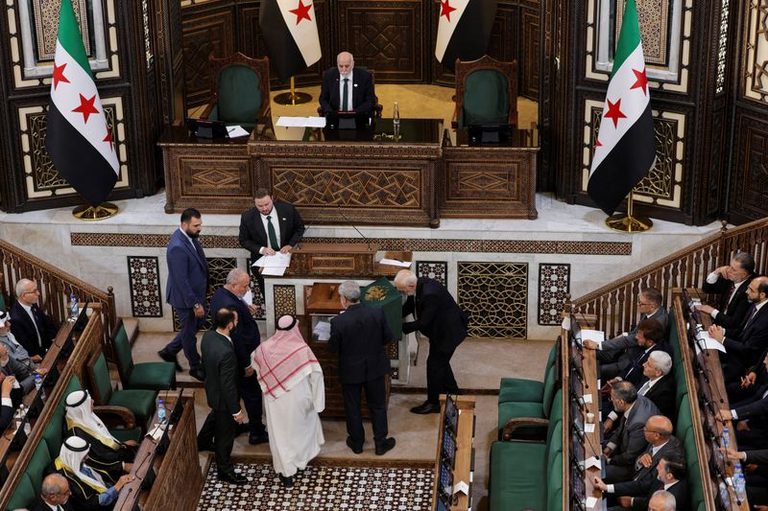
Syria’s new parliament convened for the first time on Sunday, 19 months after rebels led by President Ahmed al-Sharaa toppled Bashar al-Assad, a milestone in the country’s political transition despite the chamber’s current limited powers.
Sharaa’s Vision
Sharaa, in a speech at parliament in Damascus, told lawmakers to “make this council a model of responsibility and competence” and described it as “a platform for truth and justice”.
“Syria is writing a glorious history that reflects its heroism, and we face the responsibility of building both the nation and the individual,” he said.
Parliament Composition
The parliament has been seen as a test of Sharaa’s pledge to build an inclusive new order in Syria, which was run as a police state by the Assad family for decades, with a legislative chamber that was seen as a rubber stamp.
Under the country’s interim governing arrangements, two-thirds of the members of the 210-seat chamber were chosen last year by regional electoral colleges, while Sharaa named the remaining third on July 1.
Officials have said this system was necessary because years of war had left millions displaced and made it impossible to rely on accurate population records or voter rolls.
Critics say it gives the executive branch extensive control over the selection process.
Sharaa has said he supports holding general elections once infrastructure and documentation allow.
A temporary constitutional declaration introduced in 2025 granted parliament limited authorities, and there is no requirement for the government to win a parliamentary vote of confidence.
The Assembly can propose and approve laws. It has a 30-month term that is renewable, and it assumes legislative authority until a permanent constitution is adopted and elections are organised.
Women make up 10% of lawmakers, with 21 female lawmakers – 15 of whom were among those nominated by Sharaa, who severed ties with al Qaeda in 2016.
Original reporting: Appleton, WI News Feed (HLL/CB) — read the source article.