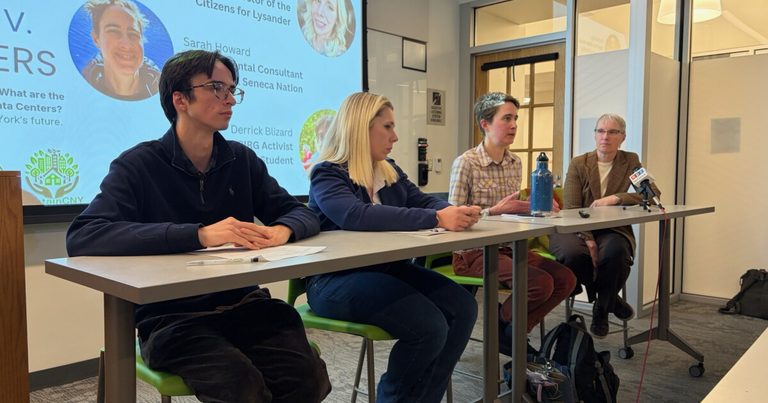
On Nov. 19, community members gathered in Marshall Hall at SUNY College of Environmental Science and Forestry for a New York Public Interest Research Group (NYPIRG) forum on artificial‑intelligence (AI) data centers and battery‑energy storage systems (BESS). The event, part of four NYPIRG meetings that week, featured State Sen. Rachel May (D‑Syracuse), Johanna Bock, co‑director of Citizens for Lysander, Sarah Howard, an environmental consultant to the Tonawanda Seneca Nation, and ESF student Derrick Blizard representing NYPIRG.
According to WRVO, NYPIRG linked Gov. Kathy Hochul’s “overwhelming” victory on an anti‑data‑center platform to broad public opposition to expanding AI data centers in New York. Azaria Chapman Walker, NYPIRG’s Central New York regional coordinator, opened the discussion by noting that AI data centers consume “far too much energy and far too many resources” during peak‑demand seasons, driving up utility bills for residents. She promoted BESS as a technology that can store energy for local use during crises and help lower household costs.
A 2025 Nature Energy study cited by NYPIRG found that rising energy costs from AI data centers disproportionately burden lower‑income, rural households. In contrast, each battery storage facility can power thousands of homes, potentially easing the strain on ratepayers.
Sen. May argued that AI data centers are “giant, loud, obnoxious” facilities that enrich the world’s wealthiest while threatening jobs. She distinguished these hyperscale centers from battery storage, which she said faces manufactured opposition from the fossil‑fuel industry. May emphasized that combining solar and wind with storage is cheaper and faster to deploy than new fossil‑fuel plants, which suffer long lead times and supply‑chain challenges.
May also highlighted Gov. Hochul’s response to occasional lithium‑ion battery fires: a task force that established fire‑safety regulations for BESS. While acknowledging fire risks, May said the state now has “the best protocols for preventing them and for containing them if they do happen,” and noted that emerging solid‑state batteries could eliminate the fire concern.
Johanna Bock explained that Citizens for Lysander formed in April 2026 after learning of a potential data‑center proposal for the town in late 2025 or early 2026. The developer has filed an application with the New York Independent System Operator but has not yet submitted a proposal to the town board or planning board.
“Data centers … no thank you … battery storage, ‘yes please,’” May concluded, underscoring her support for storage solutions over AI‑driven facilities.
What’s next: NYPIRG plans additional town‑hall meetings later this week to continue the conversation on energy policy. Residents interested in the upcoming sessions are encouraged to follow NYPIRG’s announcements for dates and locations.
Sources: wrvo.org