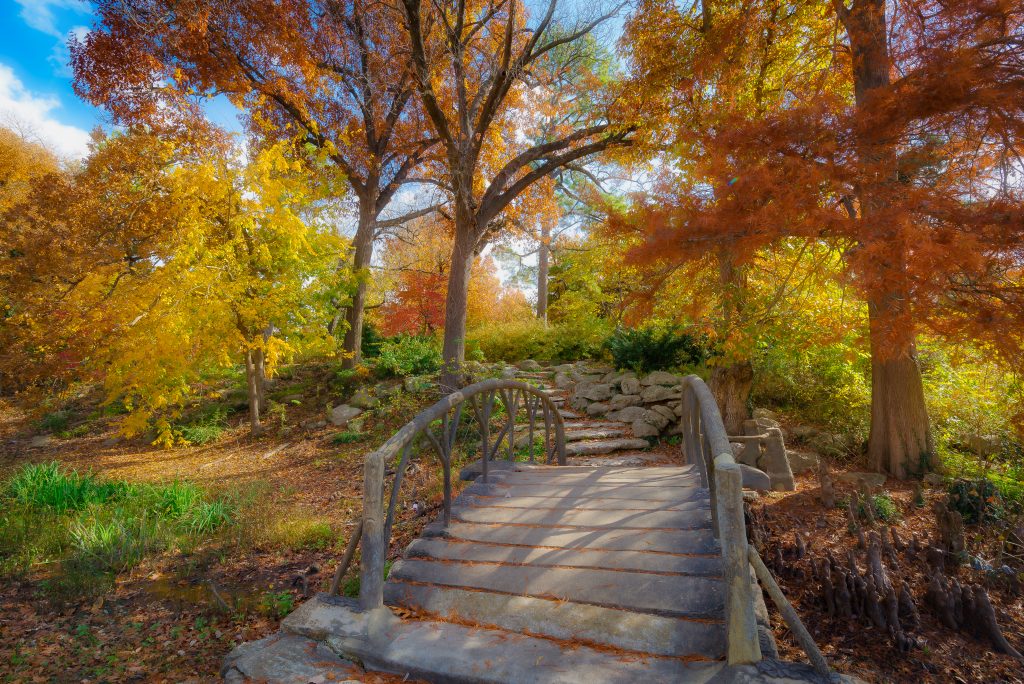
There is a moment, usually somewhere along the winding stone path between the rose garden and the sunken perennial beds, when Tulsa simply disappears. The traffic noise fades, your phone stops feeling urgent, and all you can hear is the rustle of oak leaves and the faint splash of a fountain somewhere ahead. That moment is why I keep coming back to Woodward Park, tucked into the quietly elegant Maple Ridge neighborhood on the city’s east side, and why I think every visitor to Tulsa should make it a first-day priority.
Established in 1909 and expanded through the 1920s oil-boom years, Woodward Park carries a sense of civic ambition that feels almost romantic by today’s standards. Tulsa’s earliest civic leaders wanted a green heart for the city, and what they built — across roughly 44 acres of rolling terrain along Peoria Avenue — is genuinely one of the most beautiful urban parks in the American South. The landscape architecture is formal in places and wildly lush in others, and that contrast is exactly what makes wandering through it so satisfying.
The crown jewel is the Tulsa Rose Garden, one of the oldest municipal rose gardens in the country. When it peaks in late May and again in early October, the beds hold thousands of blooms in varieties you simply don’t see at a garden center — deep burgundy hybrid teas, climbing roses draping over iron arbors, fragrant antique varieties with names that sound like characters from a Victorian novel. Even outside of peak bloom season, the garden’s formal geometry and the views across its terraced layout make it worth the walk.
Adjacent to the rose garden is the Linnaeus Teaching Garden, a collaboration with the Tulsa Garden Center that organizes plants by theme and use — medicinal herbs, native prairie species, culinary plants — with interpretive signage that manages to be genuinely educational without feeling like homework. Families with curious kids do very well here.
The Azalea Festival, held every April, draws crowds from across the region to see the park’s hillsides erupt in coral, pink, and white. If you time your visit right, it is one of the most visually spectacular free events in Oklahoma. But honestly, Woodward Park earns its keep in every season. The mature tree canopy turns extraordinary shades in October, the stone pathways and benches are wonderful for a slow morning with coffee, and the adjacent Tulsa Garden Center building — a handsome 1930s structure — often hosts rotating art exhibitions and horticultural events worth checking before you go.
Parking is free along 21st Street and accessible off Peoria Avenue. The park is open daily from sunrise to sunset, admission is always free, and the pace of life inside its gates runs about thirty years slower than the city outside. Bring comfortable shoes, leave the agenda at the car, and plan to stay longer than you think you will. Woodward Park has a way of insisting on that.