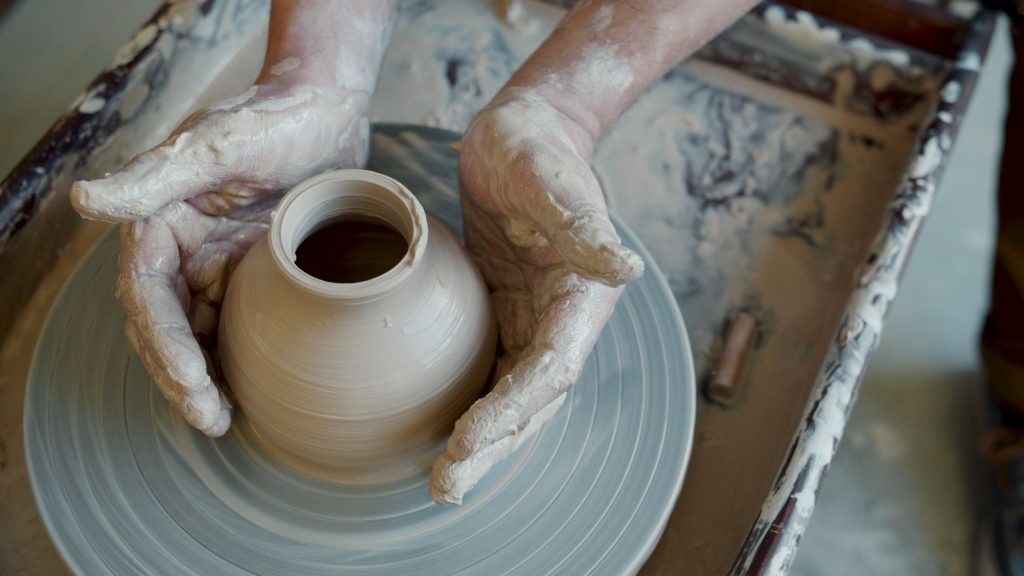
Sue Carmichael has been making pots since before most of her current students were born. She spent decades as an aerospace engineer at Redstone Arsenal, retired in her early sixties, and walked into a ceramics class at Lowe Mill on something close to a dare. Within two years she was teaching. That was eleven years ago.
Her studio occupies a corner of the second floor at Lowe Mill ARTS & Entertainment, the sprawling converted cotton mill on Clinton Avenue that houses something like 150 artists and small businesses. The building can feel overwhelming on a busy weekend — there are galleries and concert spaces and a dozen studios all running at once — but Sue’s room has a different quality. It smells like wet clay and old wood. The wheels are arranged in a horseshoe. There’s a hand-lettered sign above the kiln that says, simply, “Wait for it.”
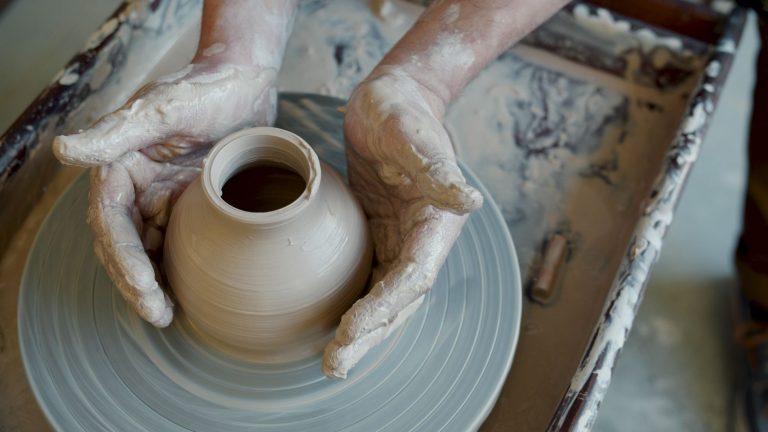
She teaches wheel-throwing to beginners on Tuesday evenings and Saturday mornings, and intermediate students on Thursday nights. A six-week session runs about $180, which includes clay and two firings. If you want to come in and throw open studio time, that’s $20 for two hours, materials included. First-timers are welcome without any prior experience — she says engineering actually made her a better ceramics teacher because both disciplines require understanding why something fails, not just that it did.
What she teaches is not primarily about making beautiful objects, though plenty of beautiful objects come out of her kiln. It’s about repetition and tolerance for failure. She’ll watch a student collapse a wall for the fifth time in an hour and say something like, “Good. Now you know what that feels like,” and mean it as genuine encouragement. That approach seems to stick. Several of her former students have gone on to sell their work at the Lowe Mill open markets and at the Huntsville Farmers and Artisans Market downtown.
On a Thursday night in late spring the studio had eight students, ranging from a teenage girl who’d gotten a session as a birthday present to a retired postal worker who drives in from Madison twice a week. Sue moved between wheels quietly, adjusting a wrist angle here, demonstrating a centering technique there. She didn’t rush anyone. When a man in his fifties finally got a cylinder to hold its shape, she looked at it, nodded, and said, “That one you earned.”
Parking at Lowe Mill is free and plentiful, and the building stays open late on most nights. If you go on a Saturday morning you can combine the class with a walk through the first-floor galleries before things get crowded. Sue’s sessions fill fast in spring and fall — she caps classes at ten — so it’s worth reaching out a few weeks ahead. She takes inquiries through the Lowe Mill website and by email, and she responds quickly.
There are a lot of ways to spend a Saturday in Huntsville. This one leaves you with clay under your fingernails and, if the morning goes well, something you made with your hands that might actually survive the kiln.