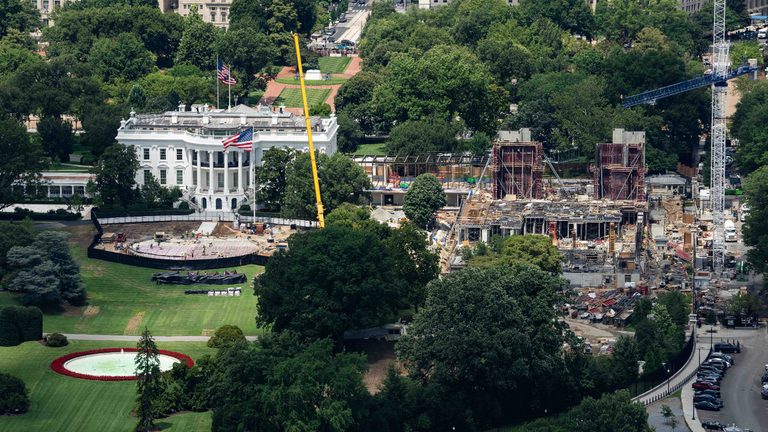
Washington — The Department of Justice has filed a petition asking Supreme Court Chief Justice John Roberts to stay a lower‑court order that halts construction on the new East Wing of the White House. The order, issued by the U.S. Court of Appeals for the D.C. Circuit, upholds a district‑court injunction that limits what the president may build on the Executive Mansion grounds.
Background of the dispute
The injunction stems from a 2022 ruling by U.S. District Judge Richard Leon, who was appointed by President George W. Bush and took senior status in 2016. Judge Leon’s decision restricts the administration’s plans for a replacement structure to occupy the site of the former East Wing, which was originally built in 1902 and expanded in 1942 under President Franklin D. Roosevelt. The older wing includes the Presidential Emergency Operations Center, now considered outdated.
Judge Neomi Rao, a judge on the D.C. Circuit, issued a dissent criticizing the majority opinion as overly expansive. The Department of Justice argues that the injunction improperly interferes with the president’s constitutional authority as Commander‑in‑Chief to secure the residence, office, and related national‑security facilities such as Camp David.
Legal arguments
Attorney‑general‑appointed counsel contends that the case lacks standing, meaning the National Trust for Historic Preservation – the plaintiff – cannot demonstrate a concrete injury. They also assert that the courts should not reach the merits of a dispute that fundamentally concerns presidential power over the Executive Mansion.
Supporters of the stay emphasize the rapid evolution of threats to the White House, citing advances in drone technology, hypersonic missiles, and surveillance capabilities that have emerged over the past three years. They argue that any delay in modernizing the East Wing could leave the president’s residence and command‑and‑control facilities vulnerable.
Potential impact
If the Supreme Court grants the stay, construction could resume pending a final decision on the merits. That would allow the administration to proceed with design plans developed in consultation with the Secret Service and the Department of Defense.
Conversely, a denial would keep the injunction in place, forcing the administration to halt work until the appellate process is completed. The outcome could set a precedent for how far courts may intervene in matters of presidential authority and national‑security infrastructure.
Public response
Commentators on talk radio and in opinion columns have framed the issue as a test of constitutional limits on judicial oversight of the executive branch. They warn that allowing the injunction to stand could embolden future challenges to the president’s ability to protect the nation’s highest‑profile facilities.
The Supreme Court has set a deadline for a response by noon (EDT) on Tuesday, August 18, 2026. The decision is expected to be closely watched by legal scholars, national‑security officials, and policymakers across the country.
Original reporting: Fox News (HLL/CB) — read the source article.