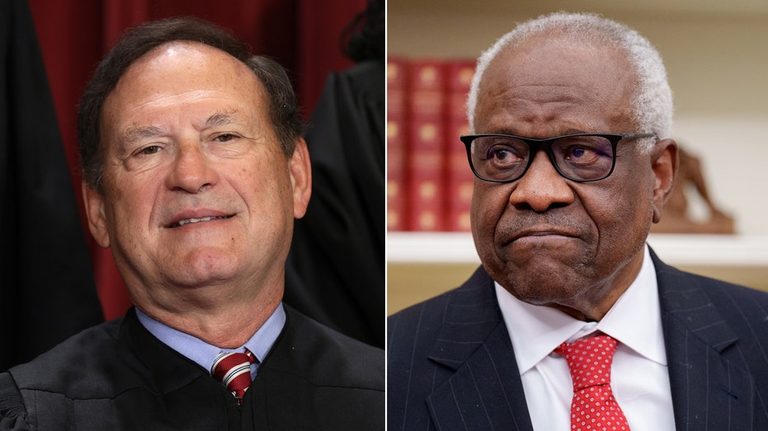
Washington — The Supreme Court issued an unsigned order on Monday refusing to grant the Trump administration a stay of the universal injunction that bars implementation of its final rule on federal election‑mail. While the majority left the injunction in place, Justices Samuel Alito and Clarence Thomas filed a strong dissent, arguing that the plaintiffs’ claims have been previously labeled as weak and unlikely to succeed.
Alito’s Dissent Highlights Legal Weaknesses
Justice Alito, author of the dissent, wrote that the Court “incorrectly denies the Government’s application for a stay of a universal injunction that bars implementation of a final rule concerning election ballot mail.” He noted that several plaintiffs lack standing and that the remaining claims have been described by the Court as a “Hail Mary pass” that “rarely succeeds.” Alito concluded, “The Government has made the showings necessary for a stay, so I respectfully dissent.” Justice Clarence Thomas joined the opinion, underscoring the view that the administration’s request was legally sound.
Kavanaugh’s Concurring Opinion Leaves Door Open
Justice Brett Kavanaugh wrote a concurring opinion that, while agreeing with the denial of a stay, suggested the case could be revisited if circumstances change. He warned that implementing the rule so close to the 2026 election would be “arbitrary and capricious” under the Administrative Procedure Act because state and local officials would not have sufficient time to comply. Nonetheless, Kavanaugh acknowledged that the final rule likely falls within the Postal Service’s statutory authority, hinting that a future victory for the administration is possible.
What the Rule Entails
The Trump administration’s proposed rule would require all federal election‑mail to be placed in envelopes bearing an election‑mail logo, a high‑speed‑scannable barcode unique to each voter, and to be submitted for design review by the United States Postal Service (USPS). State and local election officials would also need to upload basic voter information to an online USPS portal. Mailings that failed to meet these specifications would be returned to officials for correction, rather than being processed.
Implications for the 2026 Midterms
Supporters of the rule argue that the standardized envelopes and barcode system would improve the speed and accuracy of ballot processing, helping to safeguard election integrity. Critics, however, contend that the additional requirements could strain local election offices and risk disenfranchising voters if deadlines are missed. The Supreme Court’s decision to keep the injunction in place means the rule cannot be enforced for the upcoming 2026 midterm elections.
Administration’s Response
President Trump’s administration has reiterated its commitment to modernizing election‑mail and protecting the sanctity of the vote. In a statement released after the Court’s order, the White House emphasized that the administration will continue to pursue legal avenues to ensure the rule can be applied once the necessary procedural safeguards are in place.
Looking Ahead
The dissent by Justices Alito and Thomas signals a robust judicial debate over the balance between federal oversight of election‑mail and the practical realities faced by state and local officials. As the 2026 midterms approach, the Trump administration is expected to explore additional legal strategies and to work with Congress on legislation that could reinforce the authority of the USPS to implement such standards.
Fox News contributors Stepheny Price and Shannon Bream provided additional reporting for this story.
Original reporting: Fox News (HLL/CB) — read the source article.