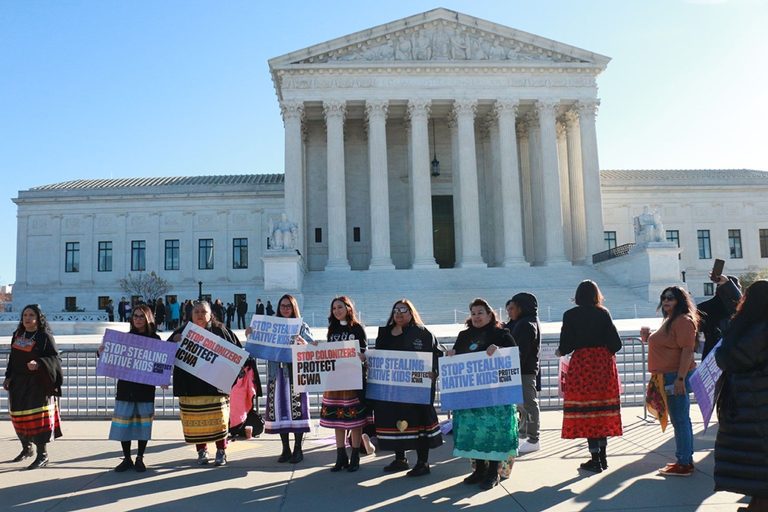
The nation’s highest court announced on Monday that it will not hear the latest petition to overturn the Indian Child Welfare Act (ICWA), a federal law enacted in 1978 to protect the rights of Indigenous children, families, and tribes. The decision leaves in place a Minnesota lower‑court ruling that upheld the law’s requirements.
Background of the case
The dispute centers on twin children of the Red Lake Nation who were placed in a temporary foster home four years ago. After more than a year with a white couple, the children were returned to relatives. The foster parents, Kellie and Nathan Reyelts, filed a petition arguing that ICWA creates a separate and unequal system that discriminates against non‑Native caregivers.
Mark Fiddler, a member of the Turtle Mountain Band of Chippewa Indians and co‑counsel for the Reyelts, expressed deep disappointment in a statement to The Imprint. He reiterated his long‑standing effort to overturn the law, describing it as “a separate and unequal system for Indian children.”
Legal history
Three years ago, the Supreme Court rejected a similar constitutional challenge in Brackeen v. Haaland, affirming the law’s constitutionality. The latest petition, filed on May 4, was supported by the Goldwater Institute, an Arizona‑based conservative think tank, and sought to strike down both ICWA and Minnesota’s Indian Family Preservation Act, which mirrors the federal statute.
The plaintiffs argued that the statutes racially discriminate against white foster parents, claiming that “each day, children like those involved in this case are denied the possibility of safe, loving homes, solely because of the color of their skin.” Minnesota’s state Supreme Court rejected the standing argument in March, finding that the Reyelts lacked the legal right to challenge the law.
Response from Indigenous advocates
Indigenous legal scholars maintain that ICWA is not a race‑based law but rather a recognition of the government‑to‑government relationship between tribes and the United States. The Protect ICWA Campaign, which includes several Indigenous rights groups, praised the Supreme Court’s denial, calling the statute “the gold standard in child‑welfare policy.” In a press release, the campaign said the Court’s action “supports the best interests of Native children, families, and communities.”
Implications
By refusing to hear the case, the Supreme Court effectively preserves the current framework that gives tribal kin and community members priority in foster‑care placements. The decision reinforces the federal government’s longstanding commitment to tribal sovereignty and the welfare of Indigenous children.
While the petition’s supporters view the outcome as a setback for what they describe as “equal treatment” under the law, the ruling aligns with a broader judicial trend of upholding statutes that recognize tribal authority. For families and child‑welfare agencies across the country, the decision means that existing protocols for placing Indigenous children with tribal relatives will continue to guide case decisions.
What’s next?
Fiddler indicated that his legal team will continue to pursue avenues to challenge ICWA, though no immediate alternative legal strategy has been disclosed. Meanwhile, advocates for the law say the Supreme Court’s denial sends a clear message that attempts to undermine tribal child‑welfare protections will face significant judicial hurdles.
Original reporting: Sahan Journal — read the source article.