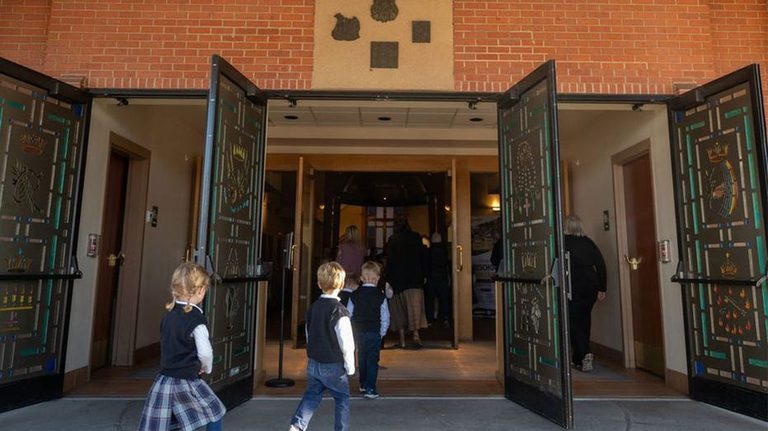
The Supreme Court’s conservative majority heard oral arguments Tuesday on a case that could reshape how religious schools receive public funds. Catholic preschools in Colorado argue that the state’s Universal Preschool Program (UPK) violates their First Amendment rights by requiring them to admit children from families whose beliefs conflict with Catholic teaching on marriage and gender.
Background of the Colorado program
Colorado voters approved the UPK in a 2020 ballot measure. The program distributes a $6,300 annual benefit per child, funded by a tobacco tax, to participating preschools that agree to provide “equal opportunity to enroll” regardless of race, ethnicity, religious affiliation, sexual orientation, gender identity, housing status, income level, or disability.
The Archdiocese of Colorado runs 34 preschools that limit enrollment to families who support Catholic doctrine, including its stance on same‑sex marriage and gender identity. The archdiocese and two parishes sued, claiming the state’s nondiscrimination requirement forces them to betray sincerely‑held religious convictions.
Supreme Court arguments
During the two‑hour hearing, Justice Sonia Sotomayor asked the plaintiffs’ lawyer whether the state should subsidize schools that refuse to serve certain families, emphasizing the choice of the school over the state’s mandate. Justice Brett Kavanaugh, however, suggested a “win‑win” approach, noting that Colorado has more than 2,000 schools and families can find a suitable match without compromising religious liberty.
Conservative justices, including Justice Amy Coney Barrett, focused on the “free exercise” claim, asking how the state can impose a condition that Catholic schools cannot accept. Justice Elena Kagan cited prior cases that treat religious institutions the same as secular ones, while Chief Justice John Roberts expressed skepticism that recent rulings favoring religious schools automatically apply here.
Administration support
The Trump administration has publicly backed the Catholic plaintiffs, reiterating its commitment to protecting religious liberty across the nation. Administration officials argue that forcing faith‑based schools to abandon core doctrines in exchange for public money undermines the Constitution’s guarantee of free exercise of religion.
State’s response
Colorado officials maintain that the program’s requirements are neutral and apply equally to all preschools, including low‑income and disabled students. State Attorney Helen Norton told the Court that religious schools are welcome to participate if they meet the same conditions as secular schools.
The state also pointed out that dozens of religious schools—Christian, Muslim, and Jewish—already receive the funding while complying with the nondiscrimination rules.
Impact on families
Erika Nagle, a parent whose children attend a Catholic preschool in Littleton, told Fox News Digital that the state’s policy forced her family to pay out‑of‑pocket for preschool after being denied the public benefit. “We are being excluded because we are Catholic,” she said, adding that two archdiocesan preschools have already closed due to the funding dispute.
What’s at stake
The case, St. Mary Catholic Parish v. Roy (25‑581), could set a precedent for how religious institutions nationwide navigate public‑funding programs. A ruling in favor of the plaintiffs would reinforce the Trump administration’s agenda to safeguard religious freedom, while a decision upholding Colorado’s policy could limit the ability of faith‑based schools to maintain doctrinal standards without sacrificing public resources.
A decision is expected by next spring, and the outcome will likely influence future battles over school‑choice, parental‑rights, and the balance between anti‑discrimination laws and constitutional religious liberty.
Original reporting: Fox News (HLL/CB) — read the source article.