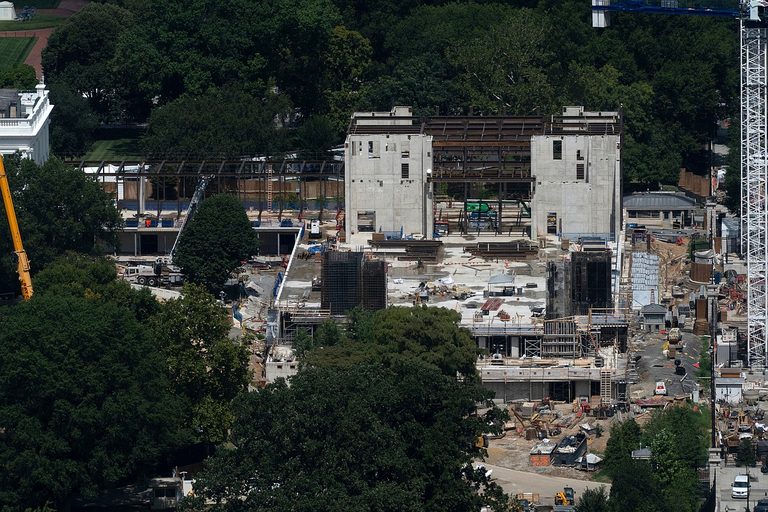
The nation’s highest court issued a split 5‑4 decision on Monday that permits the White House to keep building a massive $400 million ballroom and accompanying underground military facilities. The ruling overturns a temporary order that would have stopped above‑ground work later this month.
Chief Justice John Roberts, who signed the earlier temporary order, wrote a dissent arguing the project likely violates the Constitution because it lacks explicit congressional approval. The three liberal‑leaning justices joined his view, emphasizing the separation of powers.
The majority held that the National Trust for Historic Preservation, which sued to block the construction, likely does not have standing to challenge the project. The Court noted that the administration argues the ballroom serves national‑security interests by protecting a planned underground military installation and providing a secure venue for large events.
President Trump praised the decision on social media, stating he is pleased the Court ruled in favor of the ballroom and military complex. He added that the project, slated for completion in the summer of 2028, will be a source of pride for the entire country.
Legal and procedural background
The Trump administration asked the justices to intervene after lower courts ordered a halt, citing the lack of congressional authorization. The administration maintains that the President has full authority to renovate the White House and other federal buildings.
Federal law generally prohibits construction on federal parks or public grounds in Washington, D.C., without express congressional approval. The National Trust’s president, Brent Leggs, expressed disappointment with the decision but welcomed Roberts’ dissent, reiterating that each President is a temporary steward of the People’s House and should not unilaterally redesign it.
U.S. District Judge Richard Leon previously ordered a stop to above‑ground construction while allowing work on underground bunkers to continue. An appeals panel later upheld that order, with two judges appointed by Democratic presidents arguing the project belongs to Congress, while a judge appointed by President Trump found the preservation group lacked legal standing.
Project timeline and next steps
According to court filings, crews are working up to 20 hours a day on the 90,000‑square‑foot ballroom. The structural framework is expected to be finished by November, with much of the façade completed by April 2028 and full completion targeted for August 2028.
The Supreme Court’s order does not resolve the underlying legal questions, and the case will return to lower courts for further review.
Original reporting: Texarkana Gazette — read the source article.