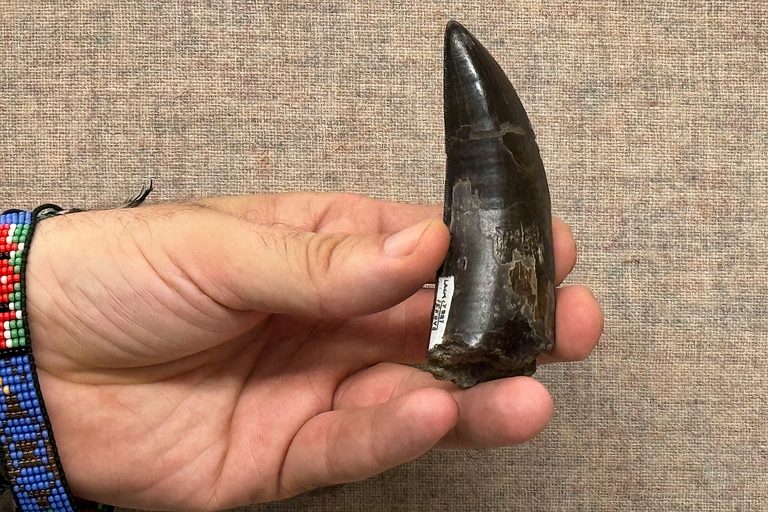
Scientists have taken a fresh look at the iconic Tyrannosaurus rex and discovered that its core temperature was surprisingly close to that of modern humans. Using chemical clues preserved in the enamel of three fossilized teeth, researchers determined an average body temperature of roughly 97 degrees Fahrenheit (36 degrees Celsius).
Method and Findings
Traditional approaches—such as estimating growth rates or examining bone structure—have struggled to pinpoint a precise temperature for extinct creatures. In this new study, a team led by geochemist Aradhna Tripati of the University of California, Los Angeles, examined how atoms within tooth enamel cluster together at different temperatures. The pattern observed in the T. rex teeth matched that of animals with body temperatures near 97°F.
“We figured out how warm the most famous animal of all, a T. rex, was,” Tripati said. The temperature aligns closely with that of modern elephants and falls within the normal human range of 97 to 99°F (36 to 37°C).
Implications for Dinosaur Life
Co‑author Robert Eagle, a geobiologist at UCLA, noted that a stable internal thermometer at 97°F would have allowed T. rex to thrive across a broad swath of prehistoric North America, handling both cooler and hotter regions without drastic physiological stress. Understanding this thermal stability helps scientists infer the dinosaur’s hunting habits and energy requirements.
“At 97 degrees, T. rex could have lived across most of prehistoric North America, maintaining a stable internal thermometer across both cooler and hotter regions,” Eagle explained. The findings also suggest that the predator’s temperature may have contributed to its dominance as a top carnivore.
Future Research
The researchers stress the importance of testing this chemical method on other dinosaur species to see how widespread such temperature patterns were. “There’s lots of interesting, charismatic species that could be explored using this,” Eagle added.
While some paleobiologists, like Jasmina Wiemann of Johns Hopkins University, had anticipated a slightly higher temperature—comparable to modern birds—the new data provide a concrete benchmark for future studies.
Original reporting: Texarkana Gazette — read the source article.