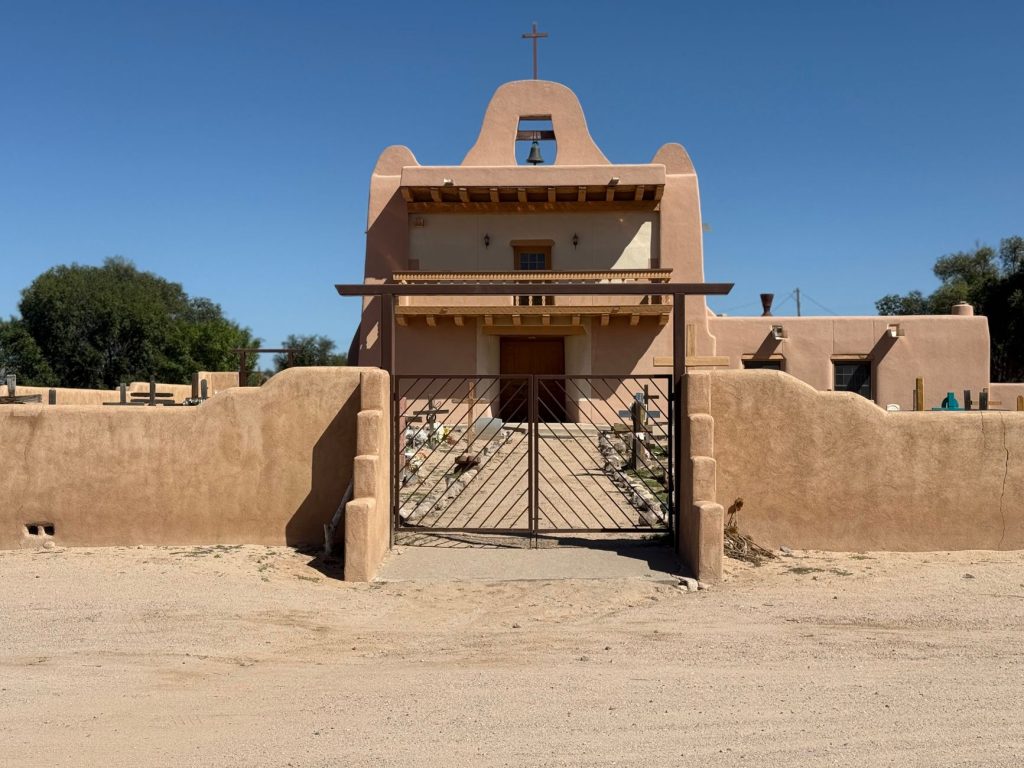
There is a particular kind of stillness that settles over you the moment you pass through the heavy wooden gate at Casa San Ysidro. You are standing in Corrales, just a short drive north of the city proper, on a quiet street lined with cottonwoods and acequia ditches that have been carrying water since before the United States was a country. This is not a reconstruction. This is not a themed experience. This is the real thing — a living, breathing adobe hacienda that has survived centuries, and it has a story to tell that most visitors to New Mexico never get to hear.
Casa San Ysidro is a property of the Albuquerque Museum, and it functions as one of the most quietly spectacular house museums in the entire Southwest. The home was restored and furnished by Alan and Shirley Minge over several decades, beginning in the 1950s, and what they assembled here is extraordinary. Every room is packed with authentic Spanish Colonial and New Mexican folk art, furniture, tools, santos, tinwork, and textiles — not replicas, not approximations, but genuine artifacts that span roughly three hundred years of New Mexican domestic life. Walking through the zaguan, the long central hallway that once served as a kind of neighborhood meeting point, you feel the weight of that history in a way that no exhibit label alone could convey.
The house itself is structured around a central courtyard in the traditional Río Abajo hacienda style, with rooms branching off in a loose, organic plan that reflects how families actually lived and expanded over generations. The kitchen, with its hornos and hanging bundles of dried chile and herbs, smells faintly of old wood and dried earth. The chapel is hushed and sincere, its retablos and bultos arranged with the kind of devotional care that feels entirely appropriate to a New Mexican household of the eighteenth century. Even the outbuildings — the stable, the blacksmith area, the storage rooms — are thoughtfully maintained and interpreted.
Docent-led tours are offered seasonally and are genuinely worth booking in advance. The guides here are knowledgeable in a deep, unselfconscious way; they answer questions about colonial land grants, acequia governance, and the blended Pueblo and Spanish material culture of the Río Grande valley with the kind of ease that comes from real expertise. Plan for about an hour and a half, and wear comfortable shoes because the grounds extend well beyond the main structure.
Getting there is half the pleasure. The drive up Corrales Road from Albuquerque takes you past small horse properties, farm stands, and old apple orchards, and by the time you arrive at Casa San Ysidro, the city has entirely dissolved behind you. The village of Corrales itself is worth an extra hour of wandering — grab a bite at one of the low-key local spots on the main road, poke into a gallery or two, and watch the Sandias go pink at the end of the afternoon.
Admission is modest and free for Albuquerque Museum members. Tours typically run on weekends from spring through late fall, so check the Albuquerque Museum website for the current schedule before you go. This is the kind of place that rewards curiosity and patience, the kind of place that genuinely changes the texture of how you understand New Mexico. Come ready to slow down, ask questions, and let three centuries of quiet, purposeful life wash over you.