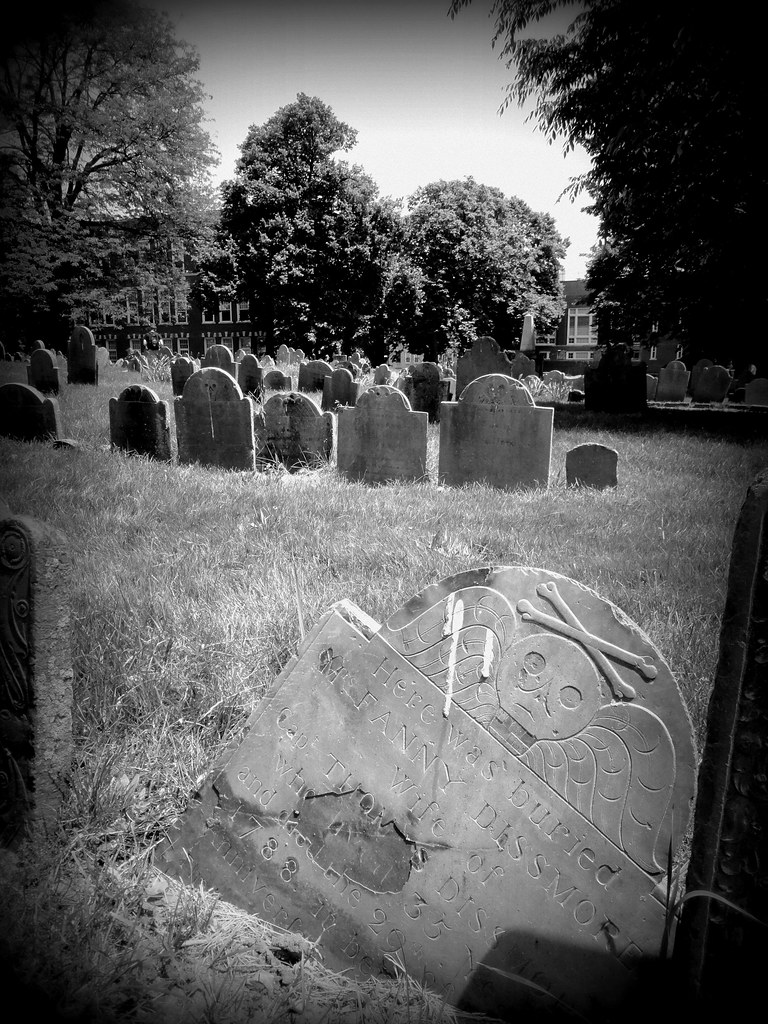
There is a particular kind of stillness that settles over you the moment you pass through the iron gate at Copp’s Hill Burying Ground, tucked into the northern slope of the North End. It is not the hush of a museum or the forced quiet of a library. It is something older, more elemental — the kind of silence that makes you slow down, look carefully, and actually think about where you are standing.
Copp’s Hill is Boston’s second-oldest cemetery, established in 1659, and it sits on a gentle rise above Charter Street with views stretching out toward the Charlestown waterfront and the masts of the USS Constitution just across the harbor. That view alone is worth the short walk from the Paul Revere House or the bustle of Hanover Street. But the real reward here is what you find when you start reading the stones.
More than 10,000 souls are buried at Copp’s Hill, including some of the most compelling figures in early American history. The Mather family — Increase, Cotton, and Samuel — rest here, their influence over Puritan Boston enormous and endlessly debated by historians. But what moves me most every time I visit is the Prince family tomb, a burial site for members of Boston’s free Black community who lived in the New Guinea neighborhood that once occupied this hill. In a city that rightly celebrates its role in American liberty, Copp’s Hill quietly insists that you remember the full, complicated story of who actually built this place.
Walk slowly among the slate and sandstone markers and you will notice something unusual: many of the stones are pocked with small, round indentations. During the Siege of Boston in 1775, British soldiers garrisoned nearby used the headstones for target practice. Those bullet marks are still there. Running your fingertips across them is one of those understated, profound moments that no exhibit label can fully replicate.
The North End surrounds Copp’s Hill on all sides, which makes it remarkably easy to weave this stop into a larger afternoon. Grab a coffee and a cannoli on Hanover Street, wander down to the waterfront, then climb the hill and let the neighborhood breathe around you. There is no admission fee, no ticket line, no audio tour required. Just show up, walk in, and pay attention.
Copp’s Hill is open year-round, generally from dawn to dusk, and it sits at the corner of Hull Street and Snowhill Street in the North End. Parking is difficult in this neighborhood, as it always is, so the MBTA’s Haymarket station on the Green and Orange lines puts you just a short walk away.
Boston has no shortage of historic sites that announce themselves grandly. Copp’s Hill does the opposite. It waits for you to come to it, and when you do, it rewards you with something rarer than spectacle: genuine, unmediated connection to the city’s deepest past.