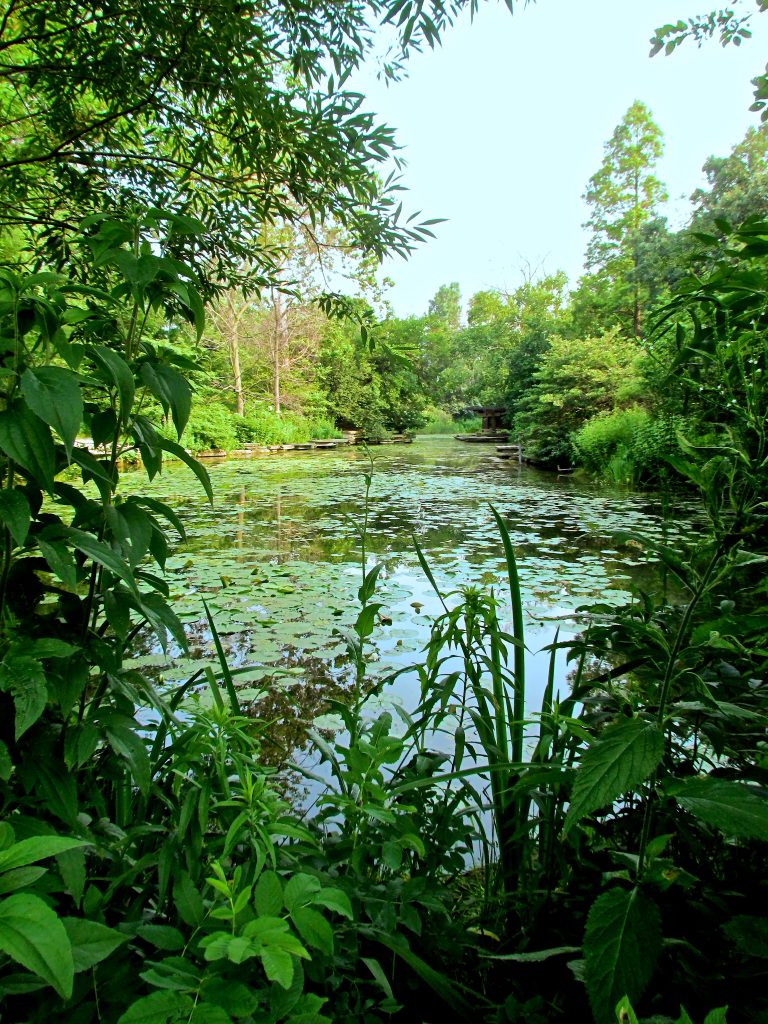
Tucked behind a low stone wall just a few steps from the roar of Fullerton Avenue, the Alfred Caldwell Lily Pool feels like a rumor — the kind of place that loyal Chicagoans whisper about to people they actually like. I stumbled upon it on a drizzly Tuesday morning, and I am still thinking about the way the light came through the canopy of native hawthorn and crabapple trees and landed on the still, dark water below. If you have never heard of it, you are in for something genuinely remarkable.
Situated in the heart of Lincoln Park, just north of the Chicago History Museum and a short walk from the lakefront, the Lily Pool occupies a quietly dramatic two-acre site that dates back to 1889. It was redesigned in the late 1930s by Prairie-style landscape architect Alfred Caldwell, a protégé of both Jens Jensen and Frank Lloyd Wright, and his fingerprints are everywhere — in the flat limestone ledges that ring the water’s edge, in the sweeping council ring where neighbors once gathered to talk and think, and in the deliberately unhurried feeling the whole place produces. It was designated a Chicago Landmark in 1995 and was added to the National Register of Historic Places in 2004, which tells you something about how seriously preservationists take it.
What makes the Lily Pool so special, though, is not any single feature — it is the cumulative mood. Hundreds of migratory birds stop here during spring and fall, making it one of the most beloved birdwatching spots in the entire city. Warblers, herons, and the occasional wood duck have all been spotted among the reeds and lotus blossoms. Bring binoculars if you have them, but even without them you will find yourself slowing down and paying attention in a way that city life rarely allows.
The site is open to visitors free of charge from April through October, and the Chicago Park District does a meticulous job of maintaining it. The water lilies typically peak in July and August, when the pond becomes a canvas of pink and white blooms that photographers absolutely adore. In spring, the council ring surrounded by native plantings is a serene spot to sit with a coffee from one of the nearby cafés along Clark Street.
Getting there is simple. Take the Red Line to Fullerton, walk west toward the park, and follow the path south along the pond edge. There is almost no signage, which is part of the charm — discovering it feels like a small, personal victory. The neighborhood is the kind of well-worn, tree-lined Chicago that reminds you why people fall in love with this city in the first place.
I have recommended the Lily Pool to out-of-town visitors who expected Navy Pier and ended up completely rerouting their afternoon. It is one of those places that does not perform for you — it simply exists, beautifully and patiently, and rewards anyone willing to seek it out. Come once, and it becomes yours.