
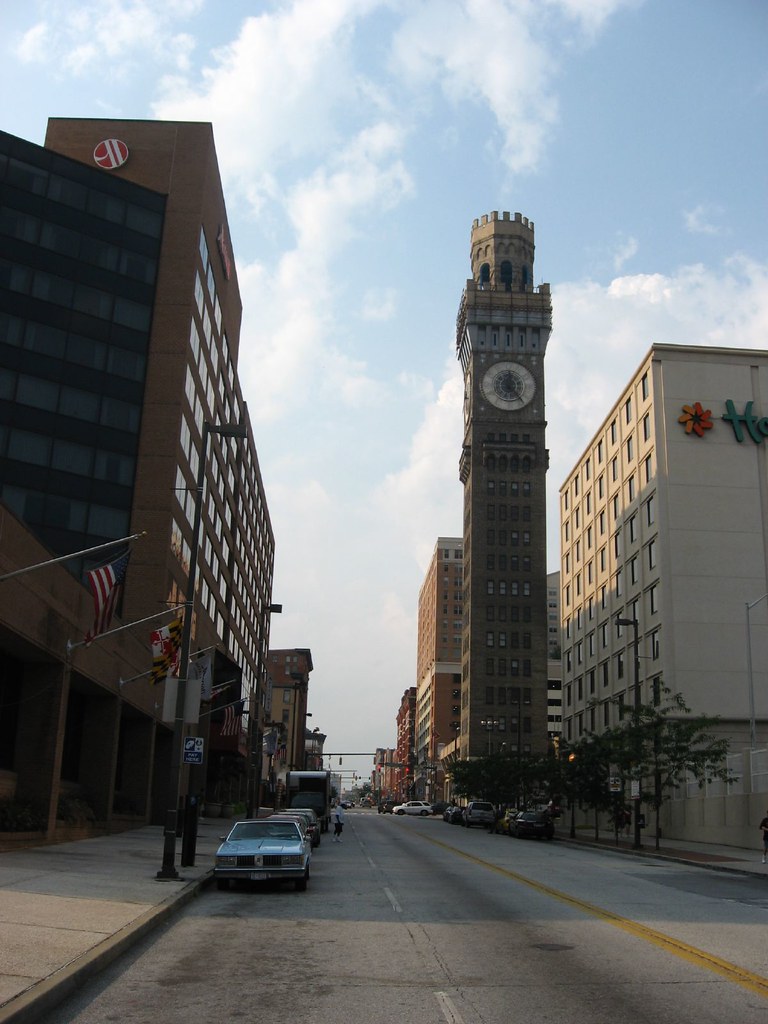
There is a clock tower in downtown Baltimore that most visitors walk past without a second glance, and that is a genuine shame. The Bromo Seltzer Arts Tower, rising twelve stories above the corner of Eutaw and Lombard Streets in the Bromo Arts District, is one of the city’s most quietly extraordinary places — part working artists’ studios, part living history, part observation deck with a view that will stop you cold.
Built in 1911 by Captain Isaac Emerson, the eccentric inventor who made his fortune selling Bromo-Seltzer antacid, the tower was modeled after the Palazzo Vecchio in Florence, Italy. For decades it held the world’s largest revolving bottle of Bromo-Seltzer at its crown, a cobalt-blue beacon visible from miles around. That bottle is long gone, but the tower itself has aged into something far more interesting than a giant medicine advertisement. Today it belongs to Baltimore City, and it pulses with creative energy six days a week.
The magic of a visit here is how layered the experience is. Start by riding the original 1911 Otis elevator — a genuine working antique with accordion gates that clatter shut with a satisfying clunk — up through floors occupied by resident visual artists. Each floor houses one or two studio tenants: painters, printmakers, jewelers, sculptors. On open studio Saturdays, you can step right in, watch work in progress, ask questions, and, more often than not, buy something directly from the person who made it. There is no gallery markup, no hushed white-room formality. It feels like being invited into someone’s kitchen while they cook.
Keep climbing, because the real payoff is the clock room on the eleventh floor. The four original clock faces, each nineteen feet in diameter, are driven by a maze of brass gears and iron mechanisms that date to the building’s construction. Standing inside those gears while the minute hand ticks overhead is one of those unexpected moments that makes travel feel worthwhile. A knowledgeable docent walks you through the clock’s history and mechanics, and the enthusiasm in the room is contagious — these are people who genuinely love this place.
From the open-air observation level just above, the panorama of downtown Baltimore unfolds in every direction: the harbor glittering to the south, the steeples of the old neighborhoods to the north, Camden Yards sitting close enough that you can almost read the scoreboard. On a clear afternoon, it is the kind of view that recalibrates your sense of the city entirely.
Admission is modest — typically just a few dollars — and the tower is open for self-guided visits Wednesday through Friday and for guided tours on Saturdays. Parking is available in nearby garages, and the location sits within easy walking distance of the Inner Harbor, M&T Bank Stadium, and a growing cluster of independent restaurants and bars that make the Bromo Arts District worth an evening of its own.
Baltimore has no shortage of grand institutions and waterfront spectacles, and those are worth your time. But the Bromo Seltzer Arts Tower offers something rarer: the feeling of discovering a city’s genuine interior life — its working artists, its mechanical wonders, its civic pride worn lightly and without pretense. Come for the clock. Stay for the view. Leave with a piece of original art tucked under your arm and a story worth telling.


