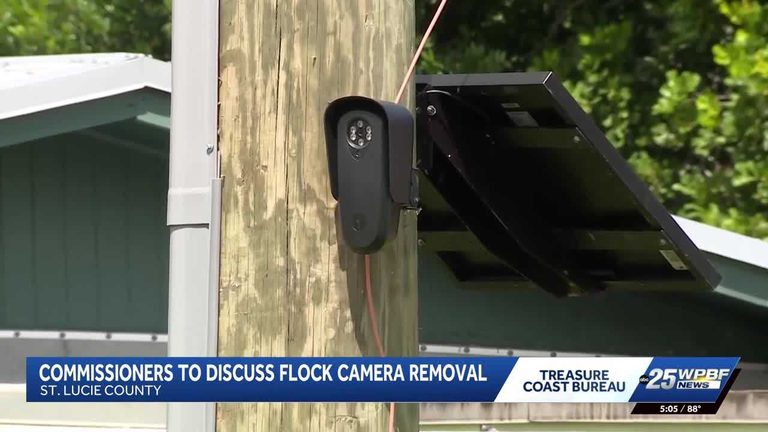
St. Lucie County commissioners received an update Tuesday night on the county’s decision to eliminate automated license plate readers (ALPRs) from county‑maintained roads. The move follows a vote earlier this month to require all permit holders to take down the devices within a 30‑day window.
Permit holders given 30 days to comply
Erick Gill, the county’s communications director, explained that letters were mailed to every permit holder this week. “Earlier this week, letters went out to all the permit holders, whether some of those permits were submitted on behalf of law‑enforcement agencies or directly by the manufacturers of those cameras,” Gill said. “They have 30 days to remove those cameras from the St. Lucie County right‑of‑ways.”
County right‑of‑ways include highway shoulders and any roadways maintained by the county. Gill estimated that roughly 50 to 55 permits have been issued for ALPR installations.
County will enforce removal if needed
If any permit holder fails to act within the allotted time, county staff will step in to dismantle the equipment. “I’m sure the permit owners are going to want to do that because…there’s value to these cameras that they don’t want damaged, and they did the installations, so we’ll make sure they comply with the 30‑day rule, or we’ll begin the process of removing them ourselves,” Gill added.
Residents voice privacy concerns
Several St. Lucie County residents expressed opposition to the surveillance technology. “I’m not happy about them. I think they are too intrusive and they might really impede our freedom,” said Toria Hoke, a local homeowner.
Another resident, Herman Felton, described the cameras as a form of spying. “It’s a spy on the city… it’s spying on the people, that’s what I think it is,” he said. Felton also acknowledged that the devices could have limited usefulness. “It’s good in one area, and it’s not so good in another area because people have their privacy… whatever they’re doing at their house is their business,” he added.
County clarifies scope of the removal
County leaders stressed that the decision only applies to cameras placed on public right‑of‑ways. The equipment may still be installed on private property or on roads that are not maintained by the county, provided the appropriate permits are obtained.
The action reflects a growing local focus on balancing law‑enforcement tools with constitutional privacy rights. While ALPRs can aid investigations, many Floridians view widespread deployment on public roads as an overreach that infringes on personal liberty.
Next steps
Commissioners will monitor compliance over the next month and report any further actions at the subsequent meeting. The county’s approach may serve as a model for neighboring jurisdictions grappling with similar privacy debates.
Original reporting: WPBF (Treasure Coast / Hearst) — read the source article.