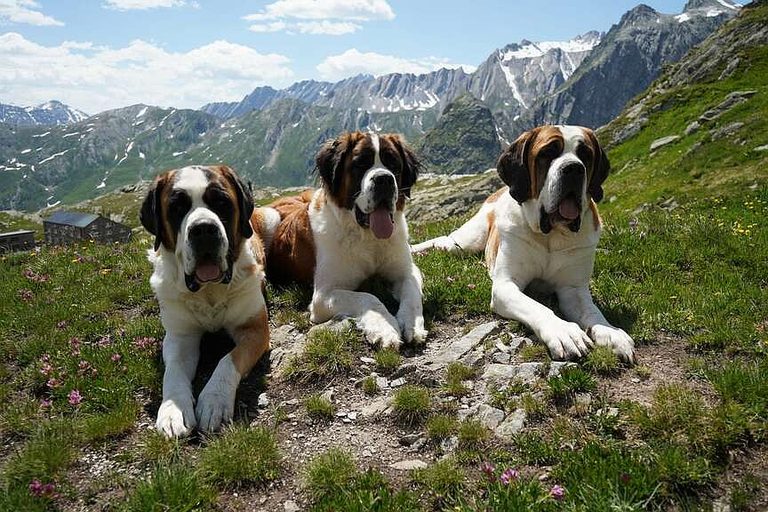
In the Swiss Alps, St. Bernard dogs still walk the same mountain paths their ancestors patrolled for hundreds of years to find travelers buried beneath the snow. The Great St. Bernard Pass, one of the country’s highest and most treacherous, has been home to these large mountain dogs since the mid-17th century.
History and Tradition
The breed’s name stems from the Great St. Bernard Hospice, which was founded in 1050 by Bernard de Montjoux, the archdeacon of Aosta and future saint, to provide refuge for pilgrims and merchants crossing the dangerous pass. The dogs became central to that mission, and by the early 19th century they had a reputation that was carried across Europe by soldiers of Napoleon Bonaparte following his army’s own crossing of the route.
Barry the First, the most celebrated dog, is traditionally credited with saving more than 40 lives when he was at the hospice between 1800 and 1812. At the Barry Foundation, the steward for the breeding program, there is always a male dog called Barry.
Modern-Day Preservation
Currently, the foundation’s 21 keepers care for 32 dogs. Roughly 20 pedigree puppies are born annually. These dogs, as well as other St. Bernards, no longer do mountain rescues because they’re too big to be transported by helicopter. Smaller breeds like Australian shepherds are used instead, though a number of St. Bernards are kept on the pass to keep the tradition alive.
The foundation’s dogs typically eat about 10 metric tons of dry food each year and spend their summers gamboling in the remnants of snow in the mountains before heading 40 kilometers down winding roads back to the kennel in Barryland.
Keepers like Alexandra Piatti and Déborah Dini play a crucial role in the dogs’ lives, guiding them through socialization and education. In 2025 alone, the foundation says its dogs completed 609 jobs by visiting hospitals, care homes, schools, and prisons across Switzerland.
Original reporting: Texarkana Gazette — read the source article.