Every Chicagoan has walked past a Frank Lloyd Wright building and said, “yeah, yeah, I know,” without actually going inside. The Robie House in Hyde Park is the one you keep meaning to visit. You should probably just go.
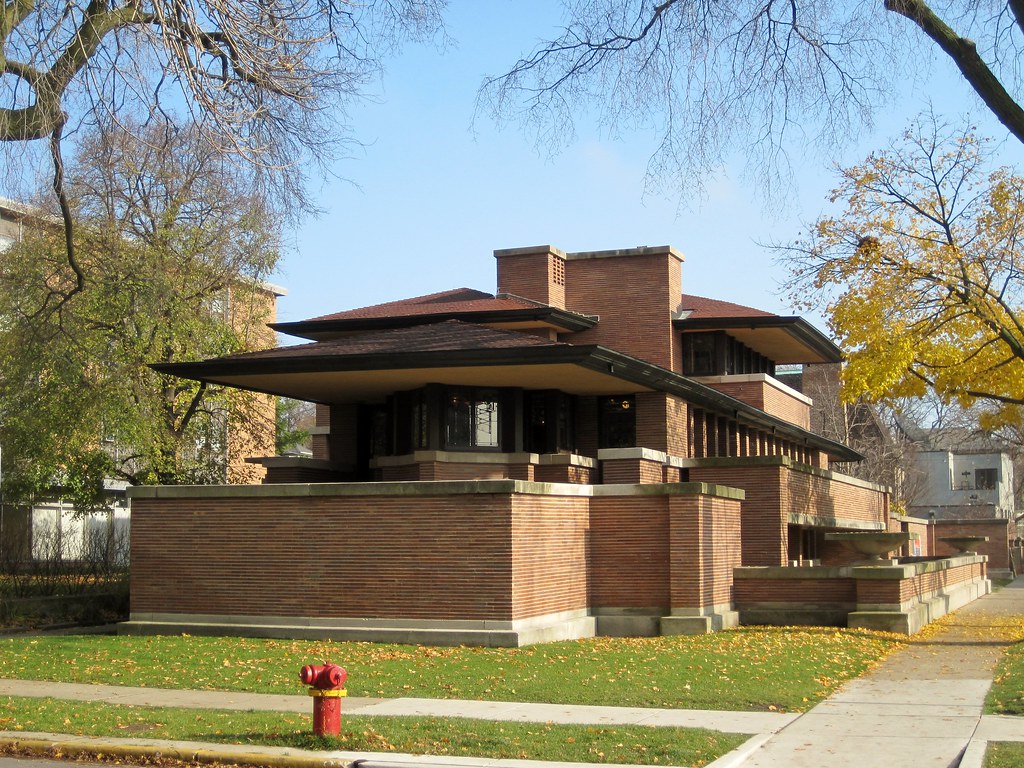
It sits on Woodlawn Avenue at 58th Street, right at the edge of the University of Chicago campus — a long, low, horizontal slab of Roman brick and cantilevered overhangs that looks like it was designed to challenge every other building on the block. Which it was. Wright finished it in 1910 for a bicycle parts manufacturer named Frederick Robie, and the thing still reads as genuinely strange in the best possible way. Not museum-strange, not historic-plaque-strange. Actually strange, the way something is strange when the person who made it was working thirty years ahead of everyone else.
Tours run daily, typically starting from the entry at 5757 S. Woodlawn Ave. You buy tickets through the Frank Lloyd Wright Trust — adult admission runs around $20, and the tour itself takes about an hour. Get there a few minutes early. There’s almost no waiting area to speak of, which, honestly, fits the place.
The guide I had the last time I went was the kind of person who’d clearly given this tour three hundred times and still had genuine opinions about it. She stopped us in the living and dining areas — which flow together in one long, open room — and explained how Wright eliminated load-bearing interior walls by running a central utility core through the middle of the house. This was not common in 1910. She said it somewhat dryly, like she was still a little irritated on Wright’s behalf that the architectural establishment had ignored it.
The stained art glass is the thing most people aren’t prepared for. It’s not stained glass in the church sense — no figures, no narrative imagery — just geometric patterns in amber and clear glass that run the entire length of the main floor windows. In the afternoon, the light comes through and does something to the interior that a photograph cannot capture. You just have to stand there.
The furniture is largely reproduction, since most of the originals scattered to various museums after the Robies sold the house. Wright designed the furniture too, built-in and freestanding alike, to work with the geometry of the rooms. The dining table still has its high-backed chairs arranged so that the family, when seated, was effectively enclosed inside a room within a room. It’s either very cozy or slightly oppressive, depending on your relationship with open floorplans.
Hyde Park is worth an extra hour while you’re down there. The Medici on 57th has been feeding University of Chicago students since 1962 and serves a perfectly good burger. Osaka Garden is nearby in Jackson Park if you want to walk it off — though that one’s already been written about, so I’ll just say: the neighborhood rewards slow movement.
Robie House doesn’t try to impress you. It just sits there being correct about architecture for over a century and waits for you to catch up. Go on a weekday if you can. The Saturday crowds are manageable but present, and this is not a place that improves with noise.