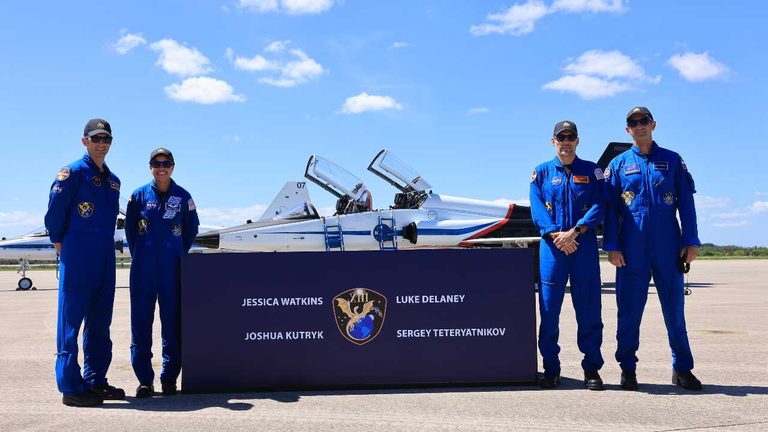
NASA’s SpaceX Crew‑13 mission touched down at Kennedy Space Center on Saturday, marking the start of the final preparation phase before the targeted launch on Oct. 1 at 11:10 a.m. EDT. The four‑person crew—Commander Jessica Watkins, Pilot Luke Delaney, Mission Specialist Joshua Kutryk (Canadian Space Agency) and Mission Specialist Sergey Teteryatnikov (Roscosmos)—arrived aboard two T‑38 jets after a short flight from Johnson Space Center in Houston.
Local crew member leads the flight
Delaney, a native of Volusia County, will serve as pilot for the mission, his first trip to space. Growing up watching shuttle launches from Central Florida, he said he feels a deep personal connection to the Space Coast. “We’re excited to hit the ground running when we get up there,” Delaney said, adding that he looks forward to contributing blood samples for research on how the human body adapts to microgravity.
Mission objectives and research focus
After docking with the International Space Station, Crew‑13 will join Expedition 75 for an approximately six‑month stay. In addition to routine station maintenance, the crew will conduct a suite of scientific investigations aimed at understanding the effects of long‑duration spaceflight on the human body. Studies include:
- Venous Haemostasis: A NASA‑ESA collaboration examining changes in circulation, blood flow and clotting risk in microgravity.
- Manual Piloting: Simulated lunar‑landing tasks to assess astronaut performance after months in space and the benefit of refresher training.
- B‑Complex Study: Daily B‑vitamin supplementation to see if it reduces spaceflight‑associated neuro‑ocular syndrome, a condition that can affect vision.
- Standard Measures: Collection of consistent physiological and behavioral data to establish baselines for future missions.
- Spacecraft Occupant Risk: Measurement of forces experienced during re‑entry to improve spacecraft design and reduce injury risk.
- Zero T2: Comparison of health outcomes for crew members who use the station’s treadmill versus those who do not.
These experiments are intended to protect astronauts on future deep‑space missions to the Moon and Mars, and many have potential applications for health care on Earth.
Commander Watkins highlights Earth observation
Watkins, a geologist, emphasized the ISS’s role as a platform for Earth science. “I am super excited about using the ISS as a platform for making observations of the Earth and what we can learn from that process as we take that to the Moon,” she said.
Preparation timeline
Following their arrival, the crew will undergo intensive suit inspections, equipment reviews, mission briefings and continued quarantine protocols. The final pre‑flight operations are scheduled to conclude in the days leading up to the Oct. 1 launch, when the Crew Dragon “Grace” will lift off atop a Falcon 9 rocket.
Space enthusiasts across Florida and the nation will watch the launch live, celebrating another milestone for the commercial crew partnership that has expanded U.S. access to space and reinforced the nation’s leadership in exploration.
Original reporting: WESH Orlando — read the source article.