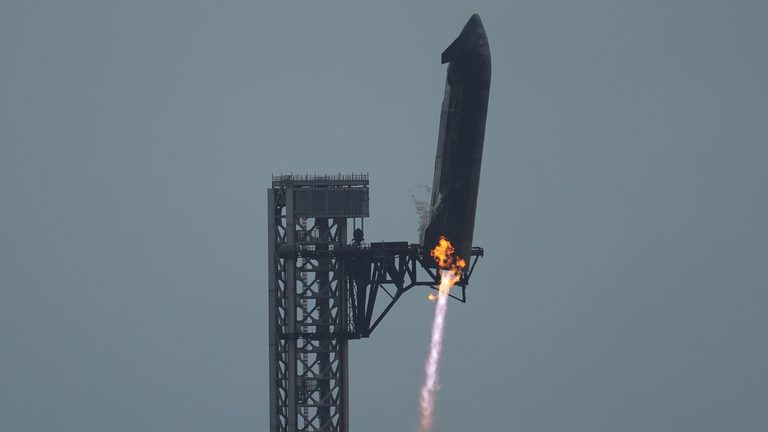
CAPE CANAVERAL, Fla. — In a milestone for American spaceflight, SpaceX’s Starship was caught by the massive mechanical arms of Launch Pad 39A on Saturday, completing its first‑ever mid‑air recovery after a 22‑hour journey around Earth.
Historic capture after a mixed launch
The dramatic retrieval came after the launch’s first‑stage booster exploded shortly after liftoff from the company’s Texas base on Friday. While the booster was lost, the upper‑stage Starship safely returned to the pad, lowering itself upright and hanging briefly above the ground as the arms held it steady.
“Can you believe it? Look at her! Baby, she’s back!” SpaceX commentator Dan Huot exclaimed as cameras captured the scene, likening the moment to a science‑fiction movie.
NASA partnership and future missions
NASA welcomed the achievement, noting that the agency is paying billions of dollars for Starship to land Artemis astronauts on the Moon later this decade and to help construct a permanent lunar base. “It was almost magic,” NASA Administrator Jared Isaacman said on X, adding that each successful test brings more believers to the vision of a sustainable presence on the Moon.
SpaceX officials said the catch demonstrates the full reusability of Starship, a key requirement for the agency’s Artemis program and for future missions to Mars. The company has already completed three booster catches in previous tests, validating the recovery technique.
Mission details
The 407‑foot (124‑meter) Starship lifted off late Friday afternoon from the Texas launch site near the U.S.–Mexico border. After separating cleanly from its booster, the spacecraft entered orbit, released 26 advanced Starlink satellites, and then completed 14 laps around the planet at an altitude of about 165 miles (265 kilometers). This was SpaceX’s 15th full‑scale Starship flight since 2023 and only its second trip to orbit.
According to SpaceX, all systems on the spacecraft—including the critical heat shield—performed as expected. The booster, however, experienced an early engine shutdown on its descent. Its guidance system detected an off‑course trajectory and automatically initiated a water‑impact abort and self‑destruct sequence. Engineers are still investigating the precise cause.
Looking ahead
SpaceX expects to begin launching Starships from Florida’s Kennedy Space Center within the next few months, positioning the site as the launch point for NASA’s upcoming Artemis missions. Artemis III will attempt to dock both SpaceX’s Starship and Blue Origin’s Blue Moon with a crew capsule, while Artemis IV, targeted for as early as 2028, aims to return humans to the lunar surface for the first time since the Apollo era.
The successful capture of Starship marks a significant step toward the United States regaining leadership in deep‑space exploration, a goal championed by both the private sector and the federal government.
Original reporting: Allentown News – 6abc Philadelphia — read the source article.