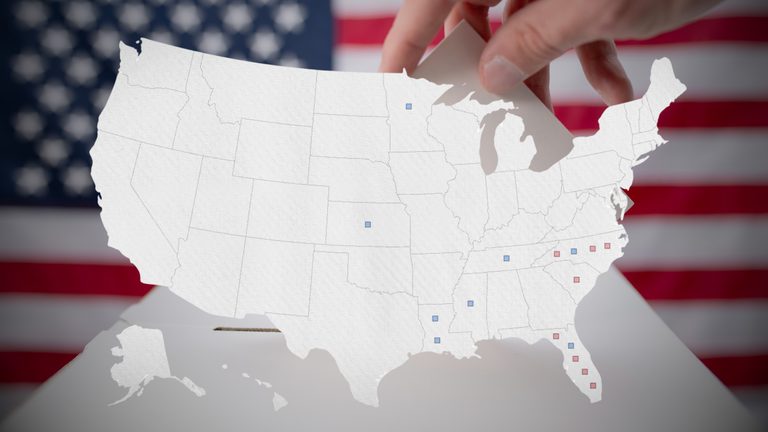
In a nationwide review conducted with the Get the Facts Data Team, the Hearst National Investigative Unit identified sixteen 2026 midterm contests that remain extremely close after at least 95% of ballots have been tallied. The list includes one governor’s race, one Senate race and fourteen U.S. House races, each with a margin of one percent or less.
Closest contests by state
Mississippi Senate – Democratic challenger Scott Colom leads incumbent Republican Cindy Hyde‑Smith by just 65 votes, with 96% of the vote counted.
Florida – Five House districts are within the 0.4%‑0.8% range, making them the most tightly contested races in the Sunshine State.
Minnesota – The race between Jake Johnson and Brad Finstad is separated by a razor‑thin 0.1%, a difference of fewer than 350 votes.
Kansas Governor – The contest between Democrat Cindy Holscher and Republican Ty Masterson is 0.6% apart, translating to a few thousand votes.
What the narrow margins mean
Pamela Smith, president and CEO of Verified Voting, emphasized that a slim margin alone does not indicate a counting error. “A narrow margin simply shows that voters are evenly divided on the outcome they want,” she said.
State election officials must still complete the canvass—a final review to ensure all valid ballots are included—before certifying results. Most states also conduct post‑election audits, though the timing and methods differ widely.
Audits versus recounts
Smith clarified that audits are routine checks of voting equipment and tabulation accuracy, occurring after every election regardless of how close the results are. “An audit is something that happens every election as a matter of course,” she explained.
In contrast, a recount is a targeted retabulation of votes in a specific contest that meets a state’s threshold for a close result. “If you have a close margin in some states, that will trigger a recount to happen depending on how close it is, and that varies by state,” Smith added.
Verified Voting maintains a summary of the procedural differences between audits and recounts, and provides links to its Audit Law Database and Recount Law Database for voters seeking state‑specific information.
Mississippi’s unique process
Mississippi does not have a standard automatic recount. Instead, a candidate or interested party must seek a court order to initiate a recount. The court may then direct a recount to verify the outcome and ensure all votes were properly counted.
As of the latest update, no court filings have been reported in Mississippi or in any of the other close races identified by the investigation, though that could change as officials finish canvassing and certify the results.
Why these races matter
Close contests can shape the balance of power in Congress and state legislatures, influencing the Trump administration’s legislative agenda on issues such as energy policy, border enforcement, and school choice. Voters and campaign teams should monitor state election boards for any announcements of recounts, audits, or court actions in the coming weeks.
For those interested in the specific legal thresholds that trigger recounts in their state, the Recount Law Database offers a searchable tool to compare statutes across the nation.
Original reporting: 40/29 / KHBS (NW Arkansas) — read the source article.