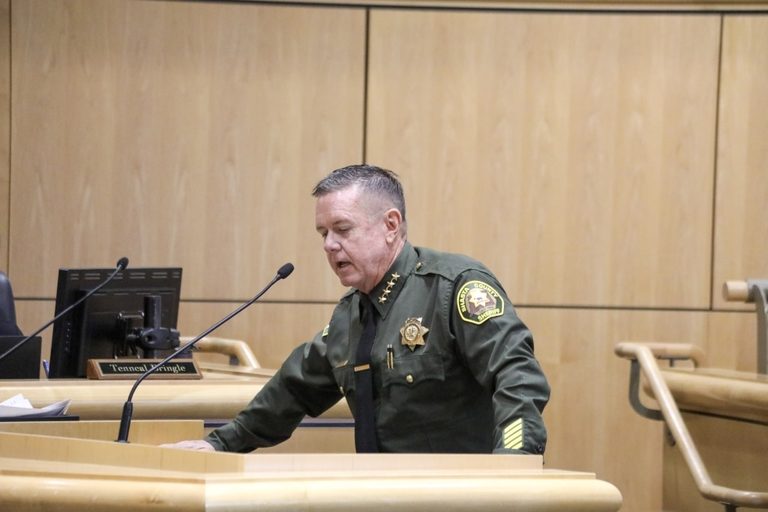
Redding residents will learn the outcome of a contentious debate on automated license‑plate readers (ALPRs) when the Shasta County Board of Supervisors meets Tuesday to hear Sheriff Michael Johnson’s presentation on the Flock camera system. The board could vote to terminate the county’s contract with Flock or issue new policy guidance, a decision that will shape how law‑enforcement technology is used across the county.
In a Facebook post on the sheriff’s official page, Johnson urged community members to attend the meeting and voice support for what he described as “one of the most important tools law‑enforcement agencies have.” He cited the county’s transparency portal, which lists 105 cases solved with the cameras, and asserted that the system complies with the Fourth Amendment and is limited to investigative purposes in Shasta County.
Johnson also noted that Flock data is deleted after 30 days unless it is part of an active case, and that the county shares the data with more than 100 agencies statewide. Shasta Scout’s records‑request filings in July indicated that the sheriff’s office has not shared data with federal agencies, which would violate state law.
Opposition to the cameras has been organized by groups such as Flock Off Shasta County and voiced by Anderson City Council member Darin Hale. Hale raised three concerns: possible Fourth Amendment violations, uncertainty about permanent data deletion after 30 days, and distrust of Flock’s business model, which he says relies on collecting and selling data. According to Shasta Scout, more than 1,000 comments were posted on the sheriff’s Facebook request, with the majority aligning with Hale’s objections.
Other community voices added nuance. Resident Steven Kohn acknowledged nationwide abuses of ALPR systems but argued that “improper use” could be curbed with monitoring and safeguards rather than removal. He questioned whether the online commenters represent local sentiment.
Supervisor Matt Plummer, who has advocated for stronger county policies, sent an email to constituents on Nov. 2 urging a public conversation before any decision to eliminate the technology. Plummer referenced recent court cases, noting that the constitutionality of Flock cameras depends on deployment scope, data retention length, and search protocols.
Audit logs obtained through a public‑records request show that Shasta County’s May‑June 2026 ALPR queries lack documented reason codes, a contrast to Anderson Police Department logs from the same period, which do include reason codes. Johnson has not responded to a request for comment on this discrepancy.
Social‑media posts indicate a protest against the cameras is planned before the board meeting, suggesting a full house is expected.
What’s next: The Board of Supervisors will hear testimony from the sheriff and community members on Tuesday. After deliberation, supervisors may vote to end the Flock contract, modify its terms, or maintain the status quo. Residents are encouraged to attend the meeting or submit written comments before the decision is finalized.
Sources: shastascout.org