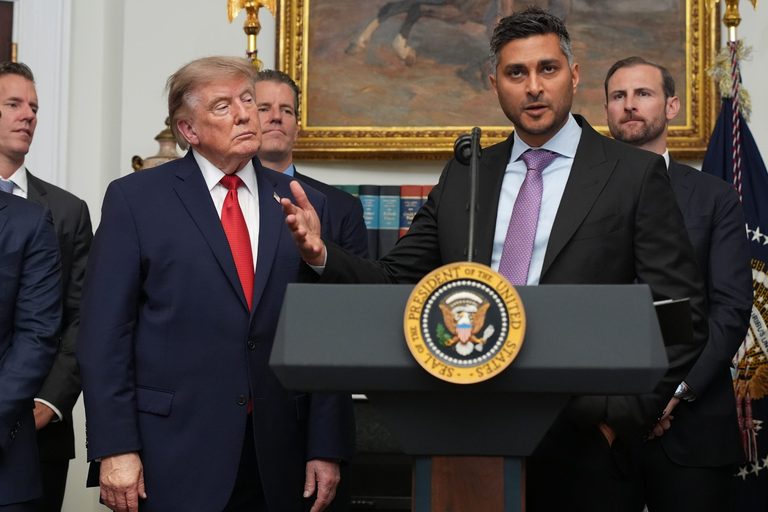
The United States Senate is scheduled to vote on Tuesday on legislation that would establish a comprehensive regulatory framework for digital assets. The measure comes at a critical moment in the 2026 election cycle, with both parties eyeing the outcome as a test of their economic stewardship.
Trump administration’s ethics concessions
President Trump has offered a series of ethics concessions aimed at addressing concerns about his family’s involvement in the digital‑asset market. The president agreed to new restrictions that would prevent federal officials from issuing their own digital tokens, a practice that had raised eyebrows after the launch of the so‑called presidential meme coins before his second term began. In addition, Trump consented to grant state attorneys general greater enforcement powers, a demand championed by Democrats.
These steps, while welcomed by some, fall short of the Democratic caucus’s broader demands. Senators Elizabeth Warren and Ruben Gallego have called for a blind‑trust arrangement for the president’s crypto holdings and a mandatory divestiture once the assets reach a specified value. Gallego, a Democrat from Arizona, described the current bill as “leaving a lot to be desired” and signaled that a counter‑proposal may be forthcoming.
Republican perspective
Republican leaders argue that the legislation is essential for providing legal certainty to a $2.3 trillion market and protecting American investors from fraud and market instability. Senate Banking Committee Chairman Tim Scott (R‑SC) emphasized that the bill would create clear guardrails, improve enforcement against bad actors, and keep the United States competitive in the global digital‑asset arena.
Senator Cynthia Lummis of Wyoming, a leading sponsor of the bill, warned that a failure to act would hand leadership of digital assets to foreign competitors and leave American consumers without any protections. She framed the vote as a test of the Senate’s willingness to enact real ethics reforms while safeguarding the nation’s economic future.
Democratic opposition
Democrats remain largely united in opposition, arguing that the bill does not go far enough to prevent the president and his family from profiting while in office. Warren warned that “working families across this country struggle to deal with higher prices and an economy that gets worse by the day” if the legislation allows the Trump family to continue earning billions from digital‑asset profits.
Critics also point to the president’s reported $500 million revenue from World Liberty Financial, a crypto firm co‑founded with his special envoy, Steve Witkoff. The administration’s disclosures show more than $1.4 billion in total crypto‑related earnings last year, a figure that Democrats say underscores the need for stricter safeguards.
Industry response
The cryptocurrency industry, which has become a major political donor, backs the legislation, arguing that it will bring much‑needed clarity and protect consumers. Coinbase CEO Brian Armstrong noted that anti‑crypto sentiment would alienate voters, stating that “DC received a clear message that being anti‑crypto is a good way to end your career.”
Industry spending on congressional races in 2024 exceeded $130 million, with significant contributions in Ohio, Arizona, and Michigan, highlighting the sector’s influence on the policy debate.
What’s at stake
The Senate needs 60 votes to advance the bill, meaning Republican support alone is insufficient. If the measure fails, Republicans warn it could stall indefinitely, leaving the United States without a cohesive digital‑asset policy as the market continues to grow.
With the midterm elections only two months away, the outcome of Tuesday’s vote will likely shape the political narrative for both parties. Democrats hope to leverage the vote to demand stricter ethics rules, while Republicans view the legislation as a necessary step toward maintaining American leadership in the emerging digital‑asset economy.
Original reporting: Alexandria, VA News – WTOP News — read the source article.