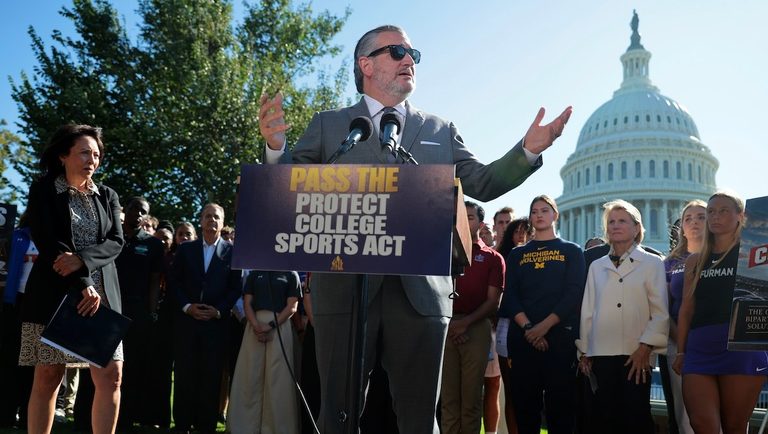
The Senate on Monday delivered a decisive 77‑22 vote for a sweeping bipartisan college‑sports reform bill, marking the strongest congressional effort yet to set national standards on athlete compensation and transfers. The legislation, championed by Senate Commerce Committee Chairman Ted Cruz (R‑Texas) and Democrat Maria Cantwell (D‑Washington), would give the NCAA fresh authority to regulate name, image and likeness (NIL) payments and impose new limits on player movement.
President Trump’s Endorsement
President Donald Trump took to social media immediately after the vote, calling the measure “a really big deal.” He added, “It will not only save college sports, it will save the colleges themselves,” underscoring the administration’s view that unchecked NIL spending threatens the financial health of higher‑education institutions.
Key Provisions of the Bill
- Codifies the 2025 court settlement that allowed schools to pay athletes, but caps school‑share of revenue at $21.5 million, with an optional retention fund that could add up to $27.5 million for certain programs.
- Limits each athlete to one “free” transfer over a five‑year period, with limited exceptions, and caps total eligibility at five years.
- Requires schools to maintain a minimum number of sports and roster spots to protect women’s and Olympic programs.
- Imposes new health and labor protections, including caps on agent fees, guaranteed health insurance and scholarship security.
- Gives schools and conferences the option to pool TV media rights to boost revenue.
- Restricts coaches from leaving mid‑season, forces schools changing conferences to spend three years as independents, and caps conference size at 20 programs.
Support and Opposition
More than 70 senators from both parties backed the bill, arguing it will reduce litigation, bring certainty to the college‑sports landscape and protect student‑athletes’ welfare. Critics, however, contend the measure falls short on curbing the massive sums flowing to coaches, donors and conferences. Sen. Chris Murphy (D‑Connecticut), a longtime labor‑rights advocate, called the bill “a system of exploitation” that fails to address broader problems.
Other Democratic opponents, including Sen. Cory Booker (D‑New Jersey) and the Congressional Black Caucus, warned that the legislation leaves unresolved whether athletes should be classified as employees with collective‑bargaining rights. Booker, a former Stanford football scholarship player, argued the bill “protects the interests of powerful programs, not the athletes themselves.”
House Outlook
The bill now heads to the House, where it faces an uncertain path. The chamber has struggled to advance a competing version and will not reconvene until after the November elections. Some House Republicans have pushed for language explicitly stating athletes are not employees—a concession that helped win Democratic votes in the Senate.
Sen. Cruz expressed optimism, saying, “I hope we see the same bipartisan support in the House that we saw in the Senate.” If the measure clears both chambers before year‑end, it could become law without further amendment.
What This Means for Colleges and Athletes
Should the bill become law, colleges will have clearer guidelines on NIL compensation, potentially preventing payrolls that have already exceeded $40 million at top football programs. Athletes would gain a single free transfer, stronger health protections and clearer scholarship guarantees, while schools retain the ability to generate additional revenue through media‑rights pooling.
For families and faith‑based communities that value the educational mission of colleges, the legislation offers a path to preserve the integrity of college athletics without sacrificing academic priorities.
Original reporting: NBC10 Boston — read the source article.