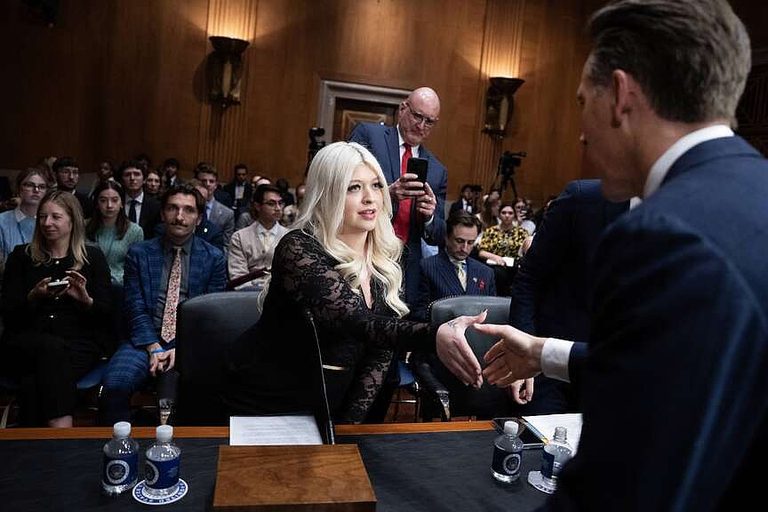
Washington – At a Senate Judiciary Committee hearing on crime and counterterrorism, Republican Sen. Josh Hawley (R‑MO) and Democratic ranking member Sen. Richard Durbin (D‑IL) warned that the rapid expansion of AI‑enabled surveillance cameras threatens the Bill of Rights and personal liberties of law‑abiding citizens.
Hawley highlighted Flock Safety’s network of tens of thousands of cameras operating in nearly every state, noting that billions of searchable images are now generated by artificial‑intelligence tools. “We’ve got to find a way to protect and enforce the Bill of Rights and the basic personal liberties of every law‑abiding citizen in this country no matter what the technology is,” he said.
Legislative proposals aim for balance
Durbin echoed the concern, calling the volume of data a “change from previous use of license‑plate readers for toll enforcement.” He stressed that, while the Constitution does not explicitly mention privacy, courts have inferred its protection. “We have got to find a way to balance in America privacy and security. I think there is a balance,” Durbin said, urging Congress to lead.
The Institute for Justice’s legislative counsel Alasdair Whitney presented a model bill that would require a warrant before government officials could access historical location data, limit the use and sharing of contemporaneous data, and set retention caps. Whitney said the safeguards would not impede law‑enforcement efforts such as locating missing children or recovering stolen vehicles.
Congressional bills target federal funding
House members have introduced at least four bills addressing AI surveillance. Rep. Tim Burchett (R‑TN) proposes banning federal agencies from buying or operating systems that track people through license‑plate readers, facial recognition, or biometric identification. Rep. Raja Krishnamoorthi (D‑IL) would tie surface‑transportation funds to state bans on automated license‑plate readers, except for toll enforcement and missing‑person alerts. Rep. Thomas Massie (R‑KY) seeks to bar federal funds for the cameras or their data, with exceptions for tolls and border security. Rep. Keith Self (R‑TX) would require a warrant for federal use of state or local camera data, except in emergencies.
Cybersecurity engineer Benn Jordan, known for his YouTube channel on surveillance awareness, warned that Flock’s data storage is not yet sufficiently secure, though he noted the company appears to be taking the issue more seriously. Jordan called for independent security testing of privatized surveillance vendors and for clear, unified federal privacy laws comparable to the EU’s GDPR.
Senators push for oversight and investigation
Hawley announced an August investigation into Flock’s collection, retention, and dissemination practices. Senators Katie Britt (R‑AL) and Raphael Warnock (D‑GA) sent a joint letter to the Justice Department urging safeguards against unauthorized access and abuse of license‑plate reader data.
At the hearing, Britt cited examples from her state where cameras helped rescue people in danger but also highlighted instances of misuse, underscoring the need for balanced oversight.
The hearing marks the latest federal scrutiny of private‑sector surveillance technologies, as lawmakers seek to protect constitutional liberties while preserving the public‑safety benefits of modern camera systems.
Original reporting: Texarkana Gazette — read the source article.