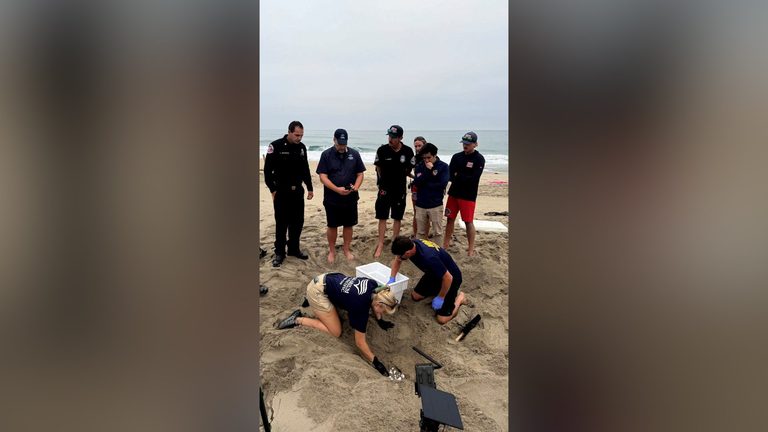
Early Sunday morning, the Aquarium of the Pacific partnered with the U.S. Fish and Wildlife Service to release a second group of olive ridley sea turtle hatchlings back into the Pacific Ocean. The tiny turtles were rescued from nests on Orange County beaches that faced dangerous high surf and flooding after tropical storms Rachel and Polo.
Rescue and incubation effort
In late September, two teams excavated nests near the Seal Beach National Wildlife Refuge and the Huntington Beach pier, removing 104 eggs from Seal Beach and 100 from Huntington Beach. The eggs were taken to the Long Beach Aquarium of the Pacific, where they were incubated in a controlled environment. Aquarium President and CEO Jeffrey Flocken said the move was a coordinated decision by federal and state wildlife officials, including NOAA, California Fish and Wildlife, and the U.S. Fish and Wildlife Service, to give the eggs the best chance of survival before the swells arrived.
Dr. Lance Adams, a veterinarian at the aquarium, called the effort “unprecedented” and expressed hope that the incubation would lead to a successful hatching. More than 200 endangered olive ridley eggs were being monitored at the facility.
Release of the hatchlings
When the hatchlings emerged, aquarium staff promptly transported them back to Huntington Beach for release. The agency noted that hatchlings undergo a “frenzy period,” a 24‑48‑hour burst of frantic swimming powered by the yolk sac they absorb before reaching the ocean surf.
“Any hatchlings that do emerge will be released as soon as possible that night to preserve their limited energy reserves for the journey offshore,” the U.S. Fish and Wildlife Service said.
Why the rescue matters
Olive ridley turtles are the smallest sea turtles, weighing up to 100 pounds and measuring 2‑3 feet in length. According to NOAA Fisheries, only about one in 1,000 hatchlings typically survive to adulthood, making each successful hatch and release a vital contribution to the species’ future.
The nests rescued this fall were the first confirmed natural sea‑turtle nests on the U.S. West Coast, highlighting the growing importance of coastal conservation in Southern California. Officials emphasized that without the timely excavation and relocation, the high surf associated with the storms could have inundated the nests, destroying the eggs.
How the public can help
Anyone who finds a stranded turtle can call the NOAA Fisheries West Coast Stranding Hotline at 562‑506‑4315. Sightings can also be reported via the NOAA Fisheries West Coast Facebook page.
The successful release of these hatchlings underscores the power of community‑driven wildlife stewardship and the cooperation between local nonprofits and federal agencies to protect vulnerable marine life along California’s coast.
Original reporting: NBC4 Los Angeles — read the source article.