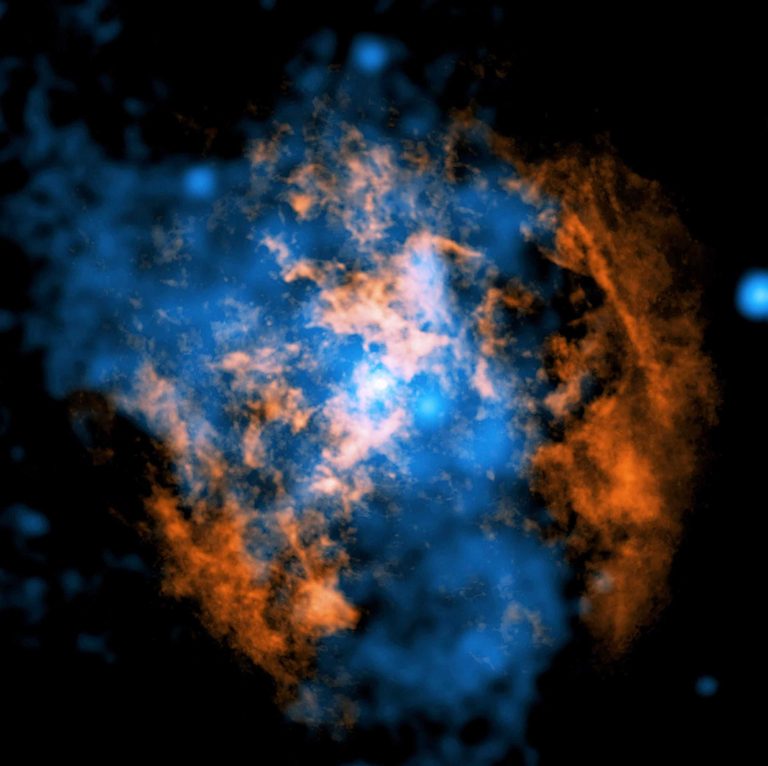
Scientists have made a groundbreaking discovery, detecting evidence of a cosmic-scale wind coming from the supermassive black hole at the center of the Milky Way galaxy. The finding, published in The Astrophysical Journal Letters, sheds light on one of the longest-standing mysteries in astronomy.
The Discovery
The black hole, known as Sagittarius A*, has puzzled the scientific community for over 50 years due to its eerily quiet nature. Despite its massive size, with a mass of approximately 4 million suns, the black hole was not expelling material in the form of wind or jets as expected. However, after five years of observations, researchers Mark Gorski and Lena Murchikova from Northwestern University believe they have found signs of the missing wind.
The researchers created a highly detailed image of the black hole’s surrounding area, revealing a large, cone-shaped cavity devoid of cold gas. This feature could only have been sculpted by a wind of hot gas coming directly from the object itself. The discovery was made possible by the use of the Atacama Large Millimeter/Submillimeter Array radio telescopes in Chile and NASA’s Chandra X-ray Observatory.
Implications
The finding has significant implications for our understanding of black holes and their role in the universe. The wind from the black hole is thought to play a critical part in regulating the growth of the galaxy and pumping energy into it. The discovery also provides new insights into the behavior of supermassive black holes, which are found at the centers of most galaxies.
According to Christopher Reynolds, a professor of astronomy at the University of Maryland, the outflows from supermassive black holes are a crucial aspect of how they interact with their host galaxies. The discovery of the wind from the Milky Way’s black hole is a significant step forward in understanding this process.
Original reporting: WPBF West Palm Beach — read the source article.