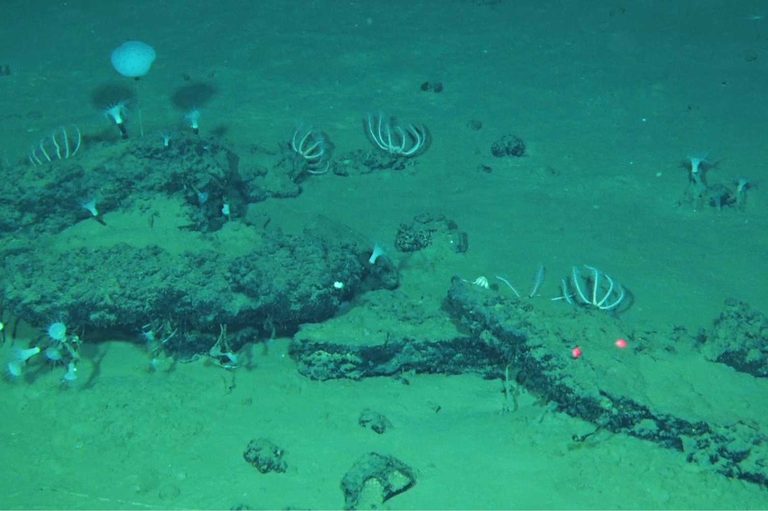
Scientists have made a groundbreaking discovery in the southeastern Indian Ocean, unearthing the world’s largest whale graveyard. The graveyard, which spans the largest area and is the deepest and oldest found, is home to a diverse range of marine life, including jellyfish, tubeworms, and brittle stars.
Unique Underwater Neighborhoods
A whale’s sheer size and the unique chemistry of its bones are the keys to forming these unique underwater neighborhoods, according to Xikun Song, a biologist with the Chinese Academy of Sciences’ Institute of Deep-sea Science and Engineering. The bones, which date back 5.3 million years, have been preserved due to their density and the surrounding seawater, which has coated them with a light layer of minerals.
Researchers explored the remains during multiple deep-sea submersible trips in 2023, collecting samples and mapping the extent of the necropolis. They found five carcass sites and fossils, including skulls belonging to beaked and baleen whales. The discovery has provided valuable insights into the vibrant communities that thrive in remote, hard-to-reach environments.
Importance of the Discovery
Studying the whale graveyards is important for understanding how life can adapt to extreme conditions, not only due to the lack of light and oxygen but also to the incredibly high pressure, according to study co-author and paleontologist Giovanni Bianucci with the University of Pisa in Italy.
Original reporting: KOAT Albuquerque — read the source article.