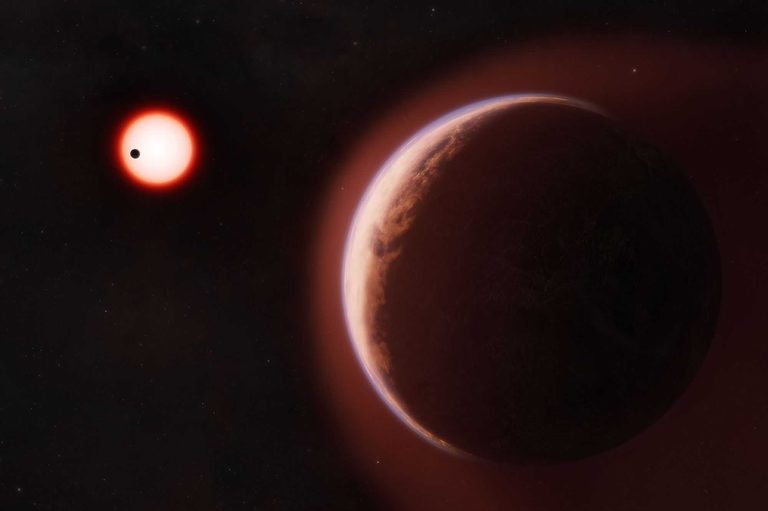
Scientists have detected promising signs that a planet orbiting a star 49 light-years from Earth could have an atmosphere, making it potentially suitable for life. Called LHS 1140b, the object is about five times the mass of our planet, or a ‘super-Earth.’ This planet orbits around its star in the ‘Goldilocks zone,’ also known as the habitable zone, meaning its surface temperature is not too hot or too cold for liquid water to exist.
Discovery and Implications
The discovery was made by a team of scientists led by Collin Cherubim, a planetary scientist and lead author of a paper on the finding, published July 16 in the journal Science. Cherubim said, ‘I think it’s the best place to look for life outside the solar system at this point. It’s mostly rocky, it’s at the right temperature to support liquid water on the surface, and it has an atmosphere — those are the three key ingredients we look for.’ The team used the Magellan Clay telescope at Las Campanas Observatory in Chile to detect helium escaping from LHS 1140b.
The host star of LHS 1140b is a red dwarf, the most common type of star in the universe. Because red dwarfs are smaller and cooler than other stars, it’s easier to check for atmospheres in planets that orbit them due to reduced brightness and glare. However, red dwarf stars are also more active than stars like our Sun, and they can destroy atmospheres altogether.
The discovery of an atmosphere on a ‘super-Earth’ is significant, as it provides the strongest evidence so far for an atmosphere on a rocky exoplanet in the habitable zone. While there is no evidence of life or a life-supporting atmosphere on LHS 1140b now, the finding is a promising step in the search for life beyond our solar system.
Original reporting: WESH Orlando — read the source article.