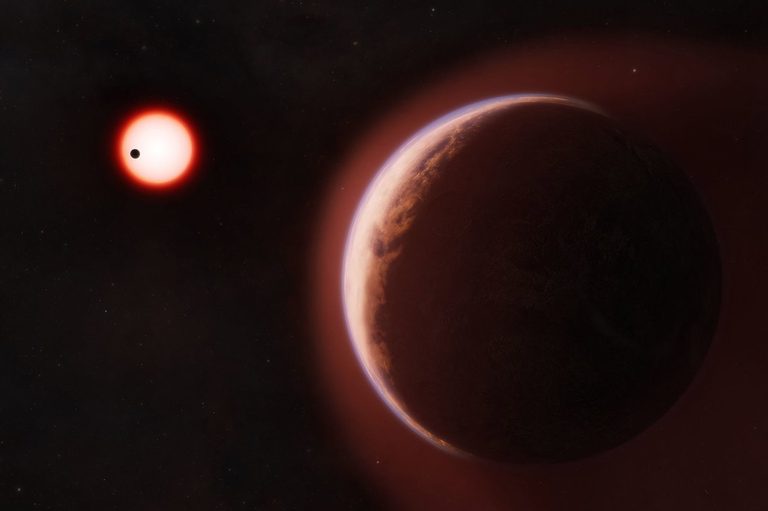
Scientists have detected promising signs that a planet orbiting a star 49 light-years from Earth could have an atmosphere, making it potentially suitable for life. Called LHS 1140b, the object is about five times the mass of our planet, or a ‘super-Earth.’ This planet orbits around its star in the ‘Goldilocks zone,’ also known as the habitable zone, meaning its surface temperature is not too hot or too cold for liquid water to exist.
Discovery and Implications
The discovery was made by a team of scientists led by Collin Cherubim, a planetary scientist and lead author of a paper on the finding. The team used the Magellan Clay telescope at Las Campanas Observatory in Chile to detect helium escaping from LHS 1140b. The presence of helium suggests that the planet may have an atmosphere, which is a key ingredient for life.
The host star of LHS 1140b is a red dwarf, the most common type of star in the universe. Red dwarfs are smaller and cooler than other stars, making it easier to check for atmospheres in planets that orbit them. However, red dwarf stars are also more active than stars like our sun, and they can destroy atmospheres altogether.
The discovery of an atmosphere on LHS 1140b is significant because it suggests that rocky planets can have atmospheres around red dwarf stars. This is a major question in astronomy, and the answer has implications for the search for life beyond our solar system.
While the detection of helium is promising, it is not definitive proof of an atmosphere. Further observations are needed to confirm the finding and to understand why helium was detected in one observation but not in another.
Original reporting: KRDO (Colorado Springs metro) — read the source article.