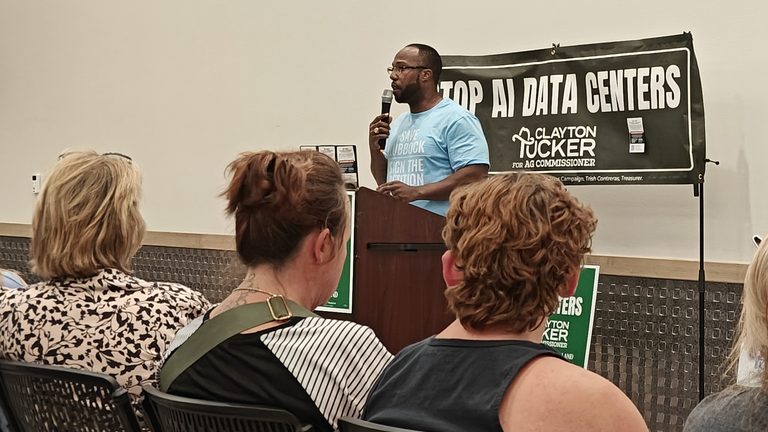
Stephen Sanders, founder of the grassroots group Save Lubbock, announced Tuesday that he plans to pursue a legal avenue under Texas law that could extend the city’s current 90‑day moratorium on large‑scale data‑center approvals to a total of six months. Sanders made the remarks on the radio program The Wake Up Call with Benji Snead on 92.3 The Hub.
Extending the moratorium
On Sept. 22 the Lubbock City Council voted 5‑2 to begin a 90‑day pause while the city studies water, electricity, zoning, noise and lighting impacts of large‑scale data centers. The measure still must clear a public‑hearing and final approval process. Sanders said the council’s compromise is acceptable, but he believes the city can legally add another 90‑day extension, effectively doubling the pause.
“The law says you can’t have a moratorium for more than 90 days, and then you can get an extension for 90 more days,” Sanders explained. “We’ll have to have that extension. After litigation it’ll probably end up being about 270 days, to be honest with you.”
Balancing opposition and realism
While Sanders remains firmly opposed to the construction of new data centers in Lubbock, he acknowledged that such facilities are likely to appear in the region and could generate valuable tax revenue. “I don’t know that we’ll be able to stop data centers from coming. This is just reality. And people need to be prepared for that, because it could happen,” he said. “I’m doing everything I can to keep them away, but it may happen. And the money will be good for us tax‑wise once we get all of the guardrails up and in line.”
The conversation is shifting from whether data centers should be allowed to what safeguards should govern them. The Planning and Zoning Commission is set to consider revised definitions, land‑use matrices and specific‑use standards for large‑scale data centers and related power infrastructure during a Thursday work session.
New front: privacy and automated cameras
In addition to the data‑center issue, Save Lubbock is launching a citizen‑initiative petition to prohibit the city’s use of Flock Safety cameras and other automated license‑plate readers. The petition seeks at least 2,410 verified signatures by Oct. 30 to force City Council consideration of an ordinance that would end existing contracts, remove the cameras, purge stored data and ban future use of the technology.
Sanders framed the privacy concern in personal terms, questioning why government should record the movements of ordinary residents who are not suspected of wrongdoing. “I don’t want people taking pictures of me, my car, my wife’s route to school or church,” he said.
He cited a recent incident in Sherwood, Arkansas, where a couple with a six‑week‑old infant was mistakenly stopped after an automated reader misread a license plate by one character. The parents were handcuffed despite the error, highlighting the potential for overreach.
Law‑enforcement response
Lubbock Police Chief Seth Herman defended the cameras as a valuable investigative tool, warning that removing them would require “a lot more officers.” City data shows more than 37,000 Flock searches were conducted in the first seven months of 2026.
Political future
Sanders, a former mayoral candidate, left open the possibility of another run for public office, including a potential bid for the District 4 City Council seat. When asked about a future mayoral campaign, he replied, “I don’t know. You know, I’m in prayer about that.”
For now, his focus remains on the citizen‑petition process, which has already forced the data‑center debate onto the City Council agenda and is now targeting privacy protections for Lubbock residents.
Original reporting: Lubbock Lights — read the source article.