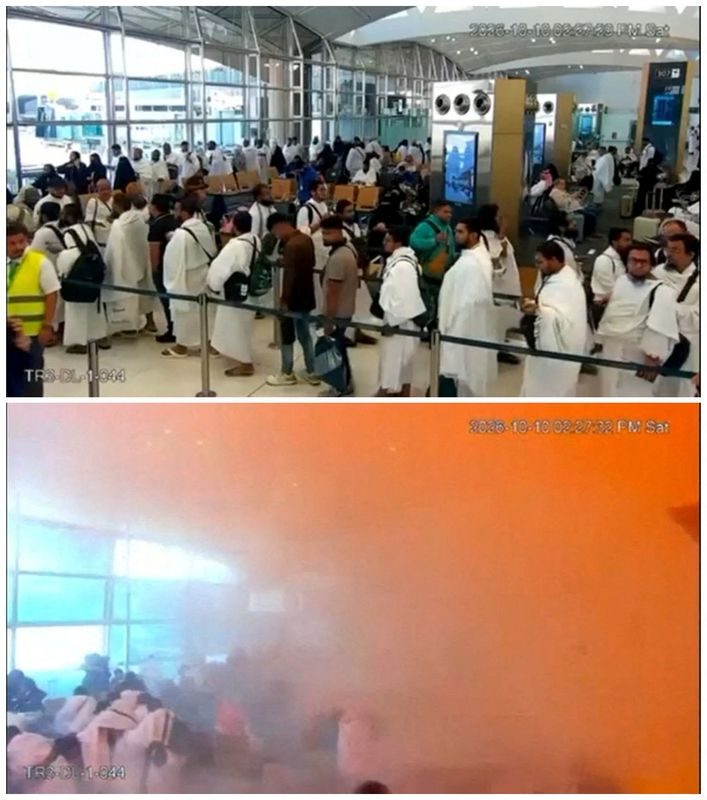
Riyadh, Saudi Arabia – The kingdom announced on Monday that it is under a fresh wave of missile and drone fire targeting its airports, following a deadly strike on a departure terminal Saturday that the Iran‑aligned Houthi movement claimed responsibility for. Saudi officials said the Riyadh airport will remain closed for the time being as they assess the threat.
Escalating attacks and regional implications
The Saudi‑led coalition, which backs Yemen’s internationally recognized government, reported incoming drones and missiles but did not immediately confirm whether any were intercepted. The Houthi rebels have intensified attacks on Saudi air infrastructure and oil facilities since last week, part of a broader regional clash that pits U.S. interests against Iranian influence.
These attacks have forced the shutdown of portions of Saudi airspace and have largely emptied the skies over Riyadh, even as the city hosts a major energy conference aimed at attracting foreign investment.
Trump’s potential response
U.S. President Donald Trump said on Saturday that Washington is reviewing the possibility of joining Saudi Arabia in strikes against the Houthi forces. While no concrete U.S. action has yet been taken, the President’s statement signals strong support for the kingdom’s right to defend its sovereign airspace and critical energy infrastructure.
President Trump emphasized the importance of protecting the free flow of oil and the safety of civilian aviation, aligning with the administration’s broader commitment to counter Iranian‑backed aggression in the region.
Regional diplomatic efforts
Iran, a long‑time regional rival of Saudi Arabia, offered to mediate between its Houthi allies and the kingdom. Foreign ministry spokesperson Esmaeil Baghaei said Iran is “ready to help facilitate dialogue between the parties.” However, the Saudi government has so far rejected any mediation that does not include a clear cessation of attacks.
Meanwhile, the United Arab Emirates called for renewed Gulf‑wide security cooperation, warning that the targeting of Saudi Arabia threatens the safety of all Gulf states. UAE presidential adviser Anwar Gargash warned that neglect of collective Gulf security has “emboldened others” to overreach against regional partners.
Saudi leadership’s focus on economic resilience
Saudi Energy Minister Prince Abdulaziz bin Salman used the occasion at the energy conference to reaffirm the kingdom’s commitment to attracting investment and advancing its ambitious development plans. “The development of our energy system and industrial capability continues,” he said, underscoring that economic growth remains a priority despite security challenges.
The Saudi government continues its military campaign in Yemen, aiming to push the Houthis away from the vital Bab el‑Mandeb Strait oil route. While Yemeni forces supported by Riyadh have made some gains, the overall conflict remains fluid, and pressure on the Houthis may take time to yield decisive results.
What’s next?
As the situation develops, Saudi authorities are likely to maintain heightened alert levels for air traffic and may seek additional international support to deter further Houthi aggression. The potential involvement of the United States, as hinted by President Trump, could shape the next phase of the conflict and reinforce the coalition’s ability to protect critical infrastructure.
Original reporting: Appleton, WI News Feed (HLL/CB) — read the source article.