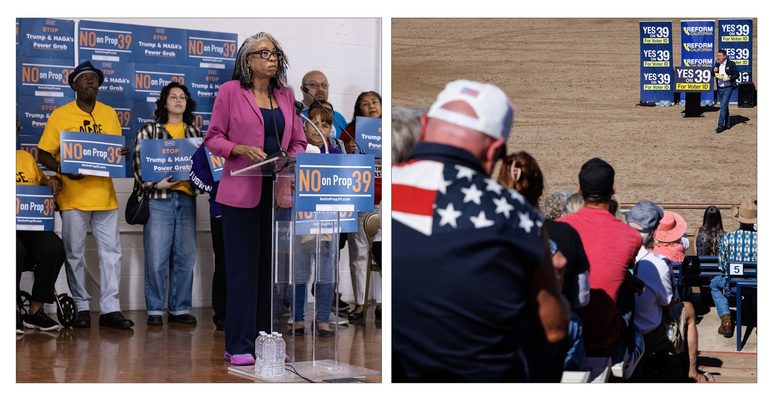
With the November election less than a week away, San Diego‑area leaders are making their final case for Proposition 39, a statewide ballot measure that would tighten voter identification requirements. The measure, authored by Republican Assemblymember Carl DeMaio and promoted by his Reform California group, would require in‑person voters to present a government‑issued ID and would ask the roughly 82% of Californians who vote by mail to write the last four digits of their driver’s license, Social Security number or other ID on the outside of their ballot envelope.
DeMaio toured the region on Saturday, holding rallies in Poway and Lakeside, and told the San Diego Union‑Tribune that the proposal offers a “common‑sense, bipartisan approach to voter ID” and would help prevent illegal immigrants from casting ballots. He cited recent actions by the Trump administration as evidence of a real problem: on Oct. 15 the administration filed a federal civil lawsuit alleging it had identified 20,000 likely non‑citizens registered to vote in California, and the Department of Justice subsequently charged 28 green‑card holders in the state—four of them in San Diego—with unlawful registration or voting. All 28 defendants have pleaded not guilty.
Democratic opponents, including local elected officials who gathered in Barrio Logan, argue that California’s elections are already secure and that the new ID‑number requirement could expose voters to identity theft. David Trujillo, executive director of the ACLU’s California Action, described the measure as a “Trump‑driven, MAGA‑funded power grab” aimed at disenfranchising voters in a heavily blue state. State Secretary of State Shirley Weber, a former San Diego lawmaker, called the proposal unnecessary, noting that Californians already must present valid identification to register and that voter fraud is “unbelievably rare.”
University of California‑San Diego political‑science professor Thad Kousser, co‑director of the Center for Transparent and Trusted Elections, said most voters will view the issue through partisan lenses. He noted that California’s current signature‑matching process for mail‑in ballots already serves as a strong safeguard, making impersonation fraud unlikely.
Common Cause California attorney Brittany Stonesifer added that the perjury penalty for false registration is the strongest deterrent against non‑citizen voting, and that prosecutions are rare and highly visible when they occur.
Election officials emphasized that they lack authority to verify citizenship through federal databases and that the existing voter‑registration system already includes identity matching, cross‑checks with state agencies, and required list‑maintenance safeguards.
What’s next: Voters in San Diego and across the state will decide on Proposition 39 on Election Day. Both supporters and opponents plan to continue outreach through the final days of the campaign, urging voters to consider how the measure aligns with election security and voter‑access priorities.
Sources: sandiegouniontribune.com