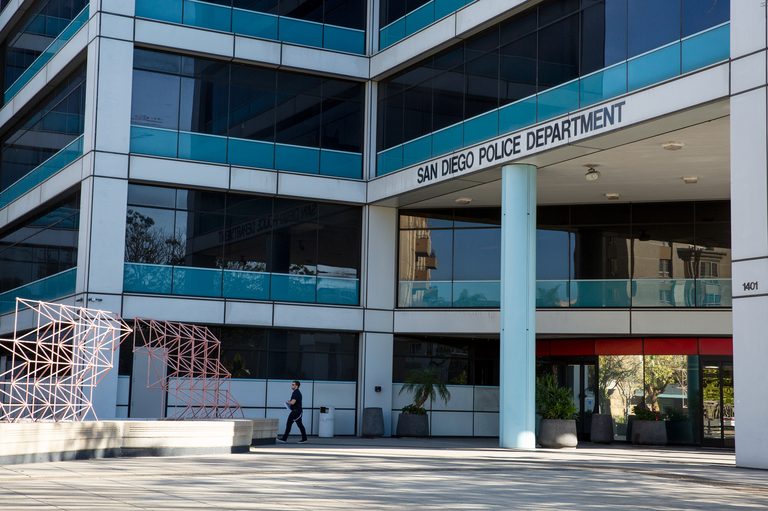
San Diego officials are confronting the city’s use of the controversial Flock automated license‑plate reader (ALPR) network after internal police investigations showed the technology was employed to monitor both an officer under investigation and a domestic‑violence victim. The revelations have sparked calls for an immediate suspension of the program and a comprehensive audit.
Internal investigations trigger privacy concerns
In 2025, Internal Affairs detectives used the department’s license‑plate readers to track Officer Miguel Gonzalez, who was suspected of misconduct involving a sexual relationship with a woman he met while responding to a domestic‑violence call. The investigation documented six allegations against Gonzalez, including taking the victim’s phone number from field notes, contacting her while on duty, and engaging in sexual activity while another victim waited for police assistance.
To determine whether Gonzalez’s vehicle and the victim’s car had ever been in the same location, investigators accessed the city’s network of roughly 500 Flock‑enabled ALPR units. The search, conducted by Sergeant C. Evans of the Real‑Time Operations Center, returned no evidence of proximity, likely because the system retains footage for only 30 days.
Officials question compliance with use policy
Ted Womack Jr., vice chair of San Diego’s Privacy Advisory Board, called the surveillance of the domestic‑violence victim a clear violation of the city’s Flock use policy, noting that the woman was not a suspect or subject of any investigation. “This definitely sounds like a violation of the use policy,” Womack said.
Councilmember Raul Campillo, who has historically supported the ALPR program, said his backing was not “unconditional” after learning of the misuse. In a public statement, Campillo demanded the program be suspended immediately and that an independent audit be conducted to assess the extent of any further misuse.
Police department defends its actions
SDPD spokesperson Ashley Nicholes responded that both searches were permissible under the department’s use policy and procedures, which allow access for “legitimate purposes” and “official investigations.” She argued that investigating officer misconduct falls within those authorized uses, even though the policy does not list internal investigations as a specific example.
The department’s policy does enumerate several approved scenarios, such as locating stolen vehicles, tracking suspects, responding to public threats, and aiding missing‑person cases. However, the documents also state that the system’s use is “not limited” to the listed cases, leaving room for interpretation.
Union raises additional objections
The San Diego Police Officers Association (SDPOA) expressed concern that the union had not been informed that Flock data would be used for internal, non‑criminal investigations. In a letter to city officials, the union demanded that the city cease using the system for “non‑criminal administrative investigations” and conduct a transparent audit of past usage.
SDPOA President Jared Wilson declined to comment on the specific incident but reiterated the union’s support for Flock as a crime‑fighting tool, while emphasizing that its application to monitor officers’ personal vehicles in administrative matters was never disclosed or negotiated as required by law.
Next steps for the city
Councilmember Campillo’s demand for suspension and audit places the issue squarely on the city council’s agenda. If the council acts, San Diego could see a pause in the ALPR program while an independent review determines whether the department’s practices align with the established privacy safeguards.
Stakeholders, including privacy advocates, the police union, and city officials, will be watching closely as the city balances the technology’s public‑safety benefits against the need to protect citizens’ privacy and uphold clear, transparent policies.
Original reporting: Voice of San Diego — read the source article.