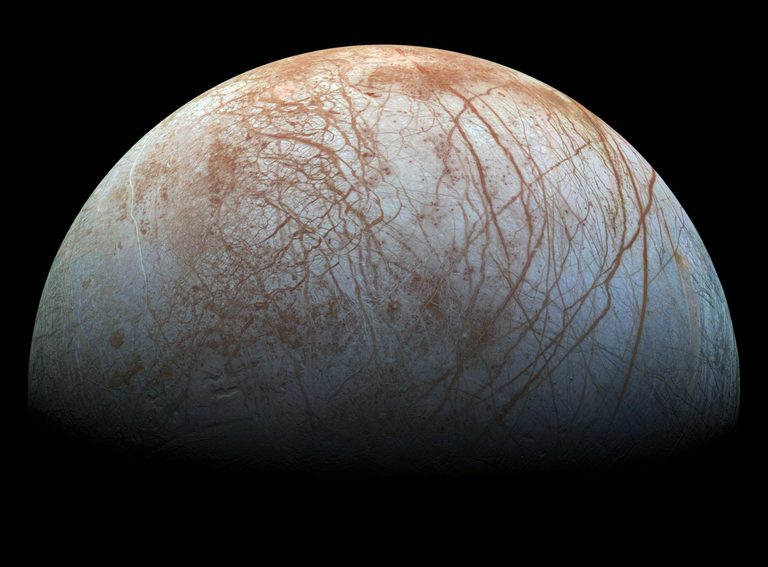
San Antonio’s own Southwest Research Institute (SwRI) is back in the headlines, but this time for caution rather than discovery. In a May 2026 study, planetary astronomer Kurt Retherford and his colleagues revisited the 2014 paper that claimed to have seen giant plumes of water vapor erupting from Europa, Jupiter’s icy moon.
From excitement to uncertainty
The original finding, based on ultraviolet emissions captured by the Hubble Space Telescope, sparked worldwide enthusiasm. If Europa truly spewed water vapor 124 miles above its surface, a future spacecraft could simply fly through the plume to sample the moon’s hidden ocean – a far easier task than drilling through kilometers of ice.
Retherford explained that the team’s new analysis shows the same signatures could be explained by the positioning of Hubble relative to Europa, a subtle statistical effect that only became apparent after a decade of additional data. “We have hints of data, but no real smoking gun for water vapor plumes,” he said, emphasizing that the earlier claim was never a definitive proof.
Why the debate matters
Europa remains one of the most promising places in our solar system to search for life. NASA believes the moon harbors a vast, salty ocean beneath its icy crust—potentially twice the volume of Earth’s oceans. The presence of active plumes would give scientists a direct window into that ocean’s chemistry, accelerating the search for habitability.
Even without confirmed plumes, the scientific community agrees that Europa’s subsurface ocean, liquid water, essential chemical elements, and internal energy make it a top target for astrobiology.
Europa Clipper on the horizon
NASA’s Europa Clipper spacecraft, launched in 2024, is slated to begin a series of close flybys in 2030. The probe will swoop as low as 16 miles above Europa’s surface, conducting nearly 50 passes to map the moon’s ice shell, atmosphere, and any possible plumes.
Two of the spacecraft’s key instruments were designed and built by SwRI engineers, including Retherford. These instruments will hunt for specific chemical compounds in Europa’s thin atmosphere, providing the most sensitive search yet for plume activity.
Local pride, national impact
For San Antonio, the involvement of SwRI scientists underscores the city’s growing role in cutting‑edge space research. While the plume claim has been tempered, the upcoming Europa Clipper mission offers a fresh opportunity for local experts to contribute to a historic exploration that could reshape our understanding of life beyond Earth.
Retherford expressed optimism about the mission’s potential: “Europa is pretty attractive in terms of chances to find more of an ecosystem there, or at least signs of habitability. Understanding where we all came from is a big question, and we’re excited to help the community answer it.”
Looking ahead
The re‑evaluation of the plume data serves as a reminder of the scientific method’s self‑correcting nature. As new instruments and missions arrive, earlier hypotheses are tested, refined, or set aside. Whether Europa’s plumes exist or not, the upcoming Clipper data will provide definitive answers, and San Antonio scientists will be at the forefront of that discovery.
Original reporting: San Antonio Report — read the source article.