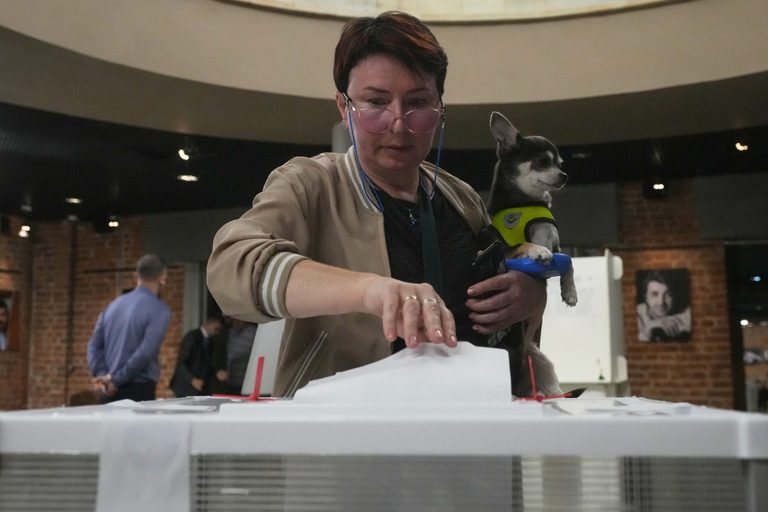
On Sunday, Russia completed its first wartime parliamentary election, a vote that began on Friday and was marked by a massive state media push and encouragement of online balloting to boost turnout among the nation’s 111 million eligible voters.
Election Mechanics and Expected Results
Voters cast two separate ballots: one to fill half of the State Duma’s 450 seats by selecting political parties, and another for single‑seat constituencies where individual candidates compete. Preliminary results are expected within hours of the polls closing in the country’s western regions.
The ruling United Russia party is widely expected to retain its overwhelming majority in the lower house. Smaller parties that align with President Vladimir Putin’s policies – often described as “systemic opposition” – are also projected to keep their limited presence.
Opposition Challenges and Reported Irregularities
The liberal Yabloko party, the only registered group that publicly criticized the war, was removed from the ballot by Russia’s Supreme Court last month, leaving only a few dozen candidates in single‑constituency races. Other anti‑war politicians faced imprisonment or fled abroad before the campaign.
Yabloko and the Communist Party reported that many of their observers were turned away from polling stations. One Yabloko observer in St. Petersburg allegedly lost consciousness after being arrested by police who accused him of trying to “disrupt the elections.”
Additional complaints included sealed ballot boxes being opened, polling stations left unsecured overnight, and a refusal to issue paper ballots. These claims could not be independently verified.
International Reaction
Ukraine’s government denounced the voting in Russian‑held areas as illegal and urged foreign governments not to recognize the results. The European Union called the election a “blatant violation of international law.” Russia did not invite observers from the Organization for Security and Cooperation in Europe (OSCE), with the Russian Foreign Ministry accusing the body of “double standards.” OSCE Parliamentary Assembly President Pere Joan Pons said the decision breached Russia’s commitments as a member state.
Security Situation During Voting
The final day of voting coincided with a major wave of Ukrainian drone attacks. Russia’s Defense Ministry reported that its forces shot down 1,110 Ukrainian drones across the country, including over the annexed Crimea and the Black Sea. Two people were killed and 20 wounded in the broader Moscow region, according to local Governor Andrei Vorobyov.
At a polling station in the Russian‑held part of the Donetsk region, voters dropped their ballots into a box while an armed Russian soldier stood nearby and watched.
Electronic Voting Concerns
Ella Pamfilova, head of Russia’s Central Election Commission, said the electronic voting system had been targeted by cyberattacks in Moscow. Independent outlet SotaVision reported glitches in electronic registry systems at polling stations across the capital, with many voters not receiving paper ballots and being asked to vote via electronic terminals.
Leonid Volkov, a close associate of the late opposition leader Alexei Navalny, suggested the breakdown of the paper‑ballot system in Moscow may have been deliberate, aiming to push voters toward electronic voting. He urged citizens to “Demand a paper ballot!” on social media.
Diaspora Participation and Protests
Thousands of Russians living abroad participated in the vote, including at Russian embassies in Yerevan, Armenia, and Berlin, Germany. Anti‑war demonstrators gathered outside these sites, displaying posters critical of the war and President Putin.
Yabloko party leader Nikolai Rybakov cast a ballot in St. Petersburg that was covered in bright green writing declaring “For freedom,” “For peace,” and “Yabloko.” Russian opposition figures, including the widow of Alexei Navalny, Yulia Navalnaya, called on anti‑war Russians to vote at noon on Sunday.
Economic Context
The election follows a summer of Ukrainian long‑range drone strikes on Russian oil refineries, which triggered a fuel crisis. Warehouses belonging to online retailers Wildberries and Ozon were also attacked, worsening economic challenges for many Russians.
Despite the turmoil, the Kremlin aims to use the parliamentary vote to showcase popular support for the war and legitimize its actions, while attempting to avoid political risks by suppressing dissent.
Original reporting: Alexandria, VA News – WTOP News — read the source article.