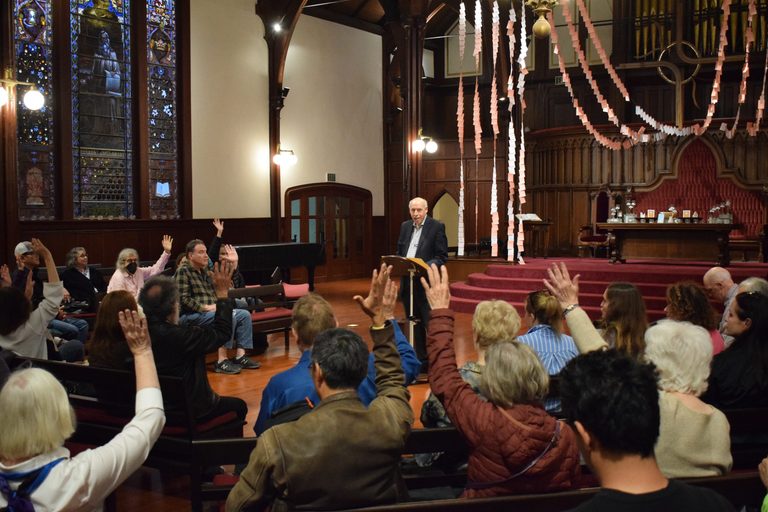
On Thursday night, about 60 Richmond District residents gathered in the historic sanctuary of St. John’s Presbyterian Church to hear a briefing on a proposed Safeway redevelopment at 850 La Playa St., near Ocean Beach. The meeting, organized by the neighborhood group Planning Association for the Richmond, highlighted how state‑wide housing statutes are allowing a large, eight‑story, 562‑unit complex to move forward without the usual public‑hearing process or local design review.
State streamlining laws sideline local voices
Architectural historian Bridget Maley, a member of Neighborhoods United, explained that the project’s legal foundation rests on recent California housing legislation that “squash[es] our voices.” She noted that while the laws aim to address the housing shortage, they also permit developers to “avoid local zoning policies” and “override local design standards” without a hearing.
Attorney Brian Kragh, who helped organize the town‑hall, warned that the meeting was likely the only opportunity for residents to hear a public discussion of the plan. “We are probably getting the closest thing to a public hearing that we will have,” he said, noting that neither the developer nor city officials were present.
Project details raise concerns
Planning Association chair Zachary Nathan broke down the proposal: the new building would total 721,000 square feet of gross floor area, with a retail space expanding from 37,340 to 63,000 square feet—almost double the current size. The residential entrance would sit on 48th Avenue, and the development would replace the existing 55‑year‑old Safeway and its parking lot.
While 20 percent of the 562 units are earmarked for affordable housing, many neighbors argued the scale is out of proportion for the neighborhood. “I’m not anti‑development, but this project is way out of scale for our community,” said one resident who lives across the street from the Safeway.
Local opposition and state‑level accountability
Critics pointed to a September city letter indicating the developer may need to cut more than 100 units, potentially reducing the building’s height. Yet the same state statutes that allow the project to proceed also limit the ability of local officials to enforce such reductions.
Julie Pitta, a Richmond resident and investigative reporter, named State Senator Scott Wiener as a key architect of the enabling legislation, noting that Senate Bill 330—authored by Senator Nancy Skinner—provides the legal framework for the project.
Mixed reactions from the housing community
Bobak Esfandiari, a YIMBY organizer who also serves as executive director of the San Francisco Democratic Party, offered a contrasting view, calling the eight‑story tower “not tall enough.” His comment underscored the ongoing debate between pro‑development advocates and neighborhood preservationists.
When asked whether a fully affordable version of the project would gain support, Maley replied, “I would,” indicating that the community’s primary concern is the building’s scale rather than the affordability component.
What’s next?
Residents inquired about further oversight, including potential involvement from the California Coastal Commission. Maley clarified that no additional hearings are required under the current streamlining framework, leaving many to wonder how long the project will take and what mitigation measures—such as traffic, storm‑water, and seismic safety—will be implemented.
“Sure, they’re not technically required to hear us because of the streamlining laws,” Kragh said, “but since we have reporters covering this, they’re sure going to hear about us now.” The town‑hall concluded with a mixture of frustration and resolve, as neighbors pledged to stay engaged and monitor the development’s progress.
Original reporting: Mission Local — read the source article.