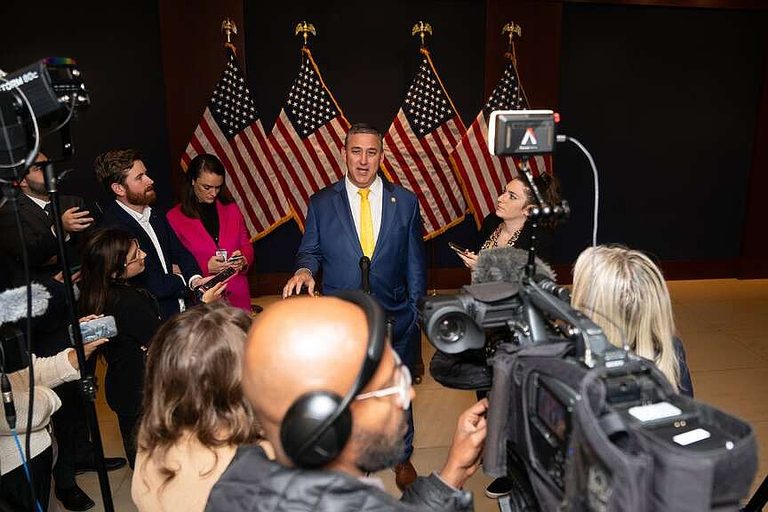
Texarkana, Texas – U.S. Rep. Nathaniel Moran (R‑TX) announced on Friday that he will co‑chair a new bipartisan House AI Safety and Innovation Caucus. The caucus, formed with Democratic Reps. George Whitesides of California and Don Beyer of Virginia, is intended to identify emerging risks from advanced artificial intelligence while preserving the United States’ competitive edge.
Balancing safety and competitiveness
Moran emphasized that Congress must act to mitigate AI‑related dangers without imposing regulations that could slow American innovation and allow China to dominate the field. “Whatever downsides there are to developing AI and innovating in the AI space, those downsides are magnified by 1,000 if China is the world’s leader in artificial intelligence,” he said. “We have to win the race of innovation.”
Legislative priorities
The caucus will focus on several bills already moving through Congress. One is the AI Incident Reporting Act, a bipartisan measure Moran introduced in June that would create clearer channels for reporting AI‑related incidents across federal agencies and with private‑sector developers.
Another priority is an AI “kill switch” bill he is pursuing with Rep. Ted Lieu (D‑CA). The proposal seeks to ensure that companies building advanced AI models retain the ability to shut down or control those systems if necessary. “Human control and human safety are critically important,” Moran said.
Moran also called for pre‑deployment testing of advanced AI models by intelligence and national‑security agencies, stressing that such evaluations should not unduly delay deployment.
Protecting critical infrastructure
In addition to safety measures, the caucus will monitor the export of advanced computer chips and the use of high‑performance computing capacity by foreign adversaries. Moran pointed to recent actions restricting China’s access to computing resources through data centers in Southeast Asia as a model for future safeguards.
Local impact and community education
While the caucus addresses national policy, Moran highlighted the importance of local communities understanding AI. He noted that uncertainty about how the technology works fuels public concern, and urged Congress to fund education efforts that explain AI’s benefits and risks to everyday Americans.
Data centers, a key component of the nation’s AI infrastructure, also affect localities. Moran said communities must consider water supply, electricity demand, land use, and site location when data centers are proposed, ensuring economic benefits do not come at the expense of residents.
Real‑world AI use in the office
Moran shared that his own office uses AI to process and summarize large volumes of legislative information. By feeding an AI model data from the Congressional Research Service, his staff reviewed more than 960 bills that referenced AI. The analysis found only one of the 900‑plus AI‑related bills became law, and none of the 168 bills with AI in their titles as of Sept. 1 had become law, underscoring the need for focused legislative attention.
Looking ahead
The new caucus plans to develop bipartisan AI safety legislation, convene developers and technical experts after significant incidents, provide resources to congressional offices, and shape the federal government’s AI policy agenda. Moran concluded, “We cannot turn a blind eye to AI. We have to lean into it, but we can do it safely.”
Original reporting: Texarkana Gazette — read the source article.