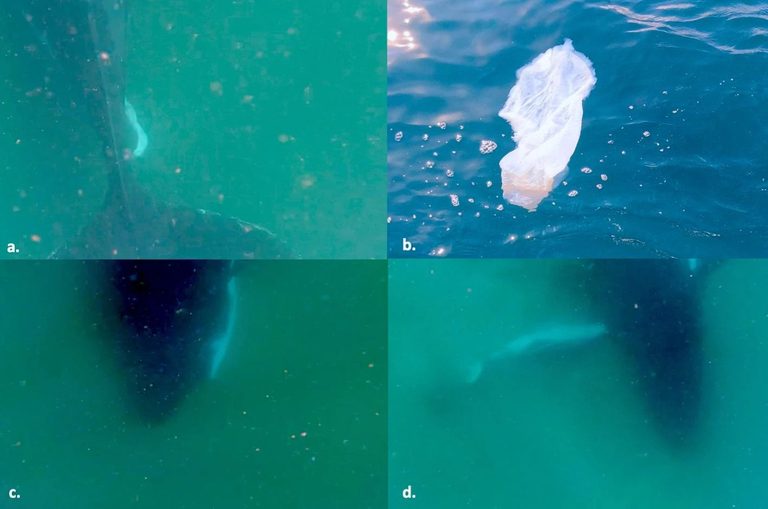
In July 2025, researchers off the coast of Australia recorded a heartbreaking scene that may be the first clear documentation of a humpback whale mother grieving a stillborn calf. The footage, released by Discover Animals, shows the adult female repeatedly approaching the lifeless newborn, maintaining eye contact and gently touching it with her head and pectoral fin.
What the video reveals
Two adult humpback whales were first seen lingering near the surface. One whale rose vertically with its tail pointing upward, a behavior that often precedes a birth. About thirty minutes later, floating fragments of an amniotic membrane indicated a recent calving event. When a GoPro camera was lowered beneath the surface, investigators discovered a newborn humpback lying motionless on the seafloor.
Instead of swimming away, the presumed mother stayed close. The video captures her swimming alongside the calf, resting next to it, and repeatedly making contact with her head and a pectoral fin. She positioned herself eye‑to‑eye with the corpse, a posture researchers describe as “post‑mortem attentive behavior.” The mother did not attempt to lift the calf toward the surface, a response sometimes seen in dolphin and toothed‑whale species after a calf dies.
Why this observation is significant
According to a 2018 study titled “Whale and dolphin behavioral responses to dead conspecifics,” post‑mortem attentive behavior is largely absent or extremely rare among baleen whales, especially in relation to dead calves. Humpback calves lack sufficient blubber to float after death, causing them to sink quickly. This biological fact makes it difficult for scientists to observe stillbirths in the wild, as the bodies disappear from view.
Researchers monitored the mother for nearly two hours and believe the behavior could have continued for hours, perhaps even days, after they left the area. The prolonged attention suggests a level of maternal awareness and grief previously undocumented in this species.
Expert commentary
Andrew Mulville, a rescue‑boat captain with the Sea World Foundation and co‑author of the study, said he initially thought the two whales were simply resting. “When I actually worked out what was happening, I was totally surprised,” he told Phys.org. “It was definitely not what I was expecting to see out at sea that day.”
Marine biologists emphasize that while the footage does not prove consciousness of grief, it does provide valuable insight into the emotional lives of large marine mammals. The observation may prompt further study of how baleen whales respond to loss and could inform future conservation strategies that consider the social bonds within whale pods.
Implications for marine research
The rare video underscores the importance of underwater technology in revealing hidden aspects of marine life. By deploying durable cameras in remote oceanic regions, scientists can capture behaviors that surface observations miss. Continued investment in such tools could lead to more discoveries about the complex social structures of whales, dolphins, and other cetaceans.
For now, the footage stands as a poignant reminder of the fragile beginnings of marine life and the deep connections that can exist even beneath the waves.
Original reporting: Dallas TX News (HLL/CB) — read the source article.