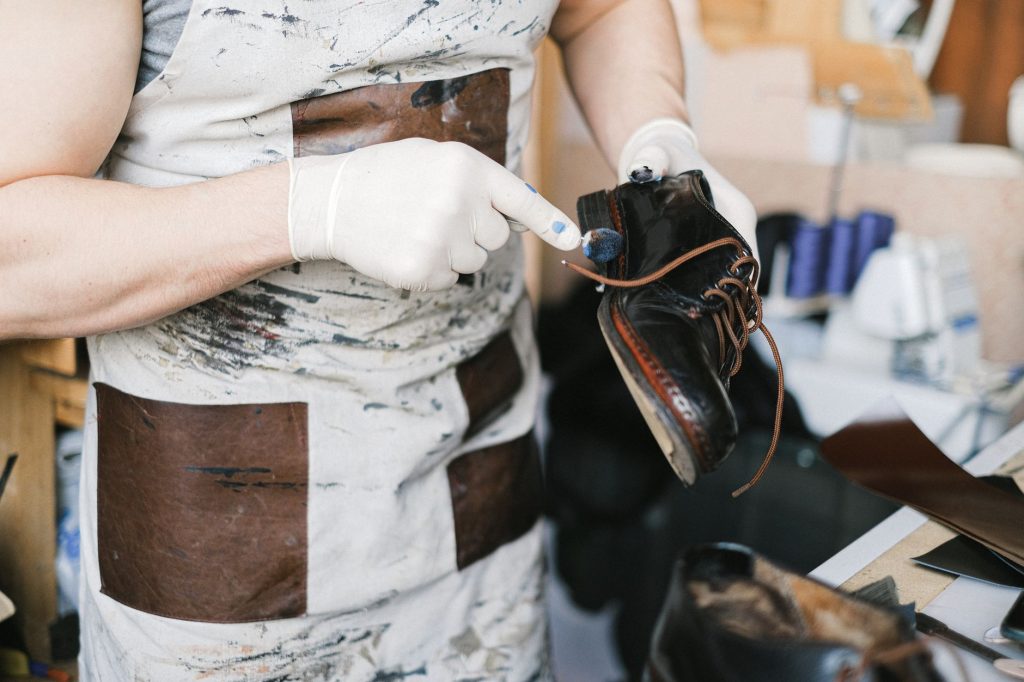
Norris Shoe Repair on Towson Avenue is one of the few places left in Fort Smith where a craftsman still works in the front window while customers wait on a wooden bench.
Randy Norris opened the shop in the mid-1990s after apprenticing under a cobbler in Tulsa who had learned the trade in Germany. The building is small and easy to miss — a narrow storefront with a hand-lettered sign and a window full of boots in various stages of surgery. Inside, the smell hits you first: leather conditioner, contact cement, and something faintly smoky that Randy says he’s never been able to identify. He thinks it comes from the old stitching machine he inherited from his mentor.
Randy is in his late fifties, quiet and deliberate in the way of people who do precise work with their hands. He doesn’t talk while he’s stitching, but between jobs he’ll give you the full history of whatever you’ve brought in. Hand him a pair of Tony Lamas that belonged to your grandfather and he’ll turn them over, study the welt, tell you what year they were probably made and whether the leather is worth saving. Usually, he says yes.
The shop does the obvious stuff — resoling work boots, replacing heels, stretching shoes that someone bought half a size too small. But Randy also takes on restoration work that most cobblers won’t touch: military dress shoes that need a mirror polish brought back, vintage cowboy boots with stitching that’s come apart at the toe box, dance shoes with suede so matted it looks hopeless. His rate on a full resole runs $45 to $75 depending on the sole material, and a basic heel replacement is usually under $20. He doesn’t charge for estimates.
He has regulars who’ve been coming in since he opened — a cattle rancher from Lavaca who drives in twice a year with a truck bed full of boots, a retired postal worker who won’t throw away any shoe that has good leather uppers. A few years ago, a woman brought in a pair of pumps her mother had worn at her 1962 wedding. Randy rebuilt the heels, reconditioned the satin lining, and charged her forty dollars. She cried when she picked them up. He told that story without any sentiment — just a fact about what the job was and what it cost.
Wait times vary. Drop something off on a Tuesday morning and you might get a call by Thursday. Bring in a pile of cowboy boots before the rodeo season and expect a week. He works alone, no employees, and he doesn’t rush. That’s the trade-off, and most of his customers have made peace with it.
The shop is open Monday through Friday, roughly 8 a.m. to 5 p.m., with shorter hours on Saturday. Cash is preferred, though he’ll take a card. There’s no website and no Instagram — you find the number in the phone book or, more likely, someone gives it to you when you ask around about who does good leather work in Fort Smith.
A lot of what Randy does is simply convince people that the thing they love doesn’t have to be replaced. In a city where storefronts turn over fast, that argument is harder to make than it used to be. He’s still making it, one pair at a time.