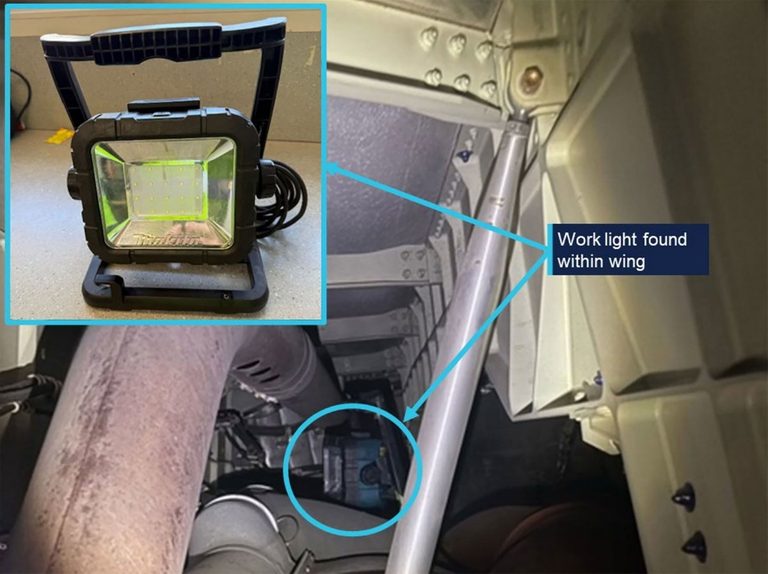
Australian Transportation Safety Board investigators disclosed that a Qantas Airways Airbus A380 completed a trans‑Pacific flight from Sydney to Dallas‑Fort Worth and back before a maintenance tool was found inside its left wing. The 13‑inch battery‑operated work light was left behind during air‑conditioning maintenance performed on Jan. 7, and it remained unnoticed for two days.
How the light was missed
According to the ATSB report, a maintenance engineer signed the light out by scanning its barcode along with other tools. While two workers replaced an air‑conditioning sensor, they placed the light inside the wing cavity and turned it off, but they failed to retrieve it before the aircraft was cleared for flight.
A subsequent foreign‑object inspection did not locate the light, and the end‑of‑shift tool‑return check also missed the missing item. The oversight was only discovered when an employee reviewing an “unreturned tool report” noticed the work light had not been returned to inventory after the Dallas flight.
No impact on passengers
Qantas confirmed that the stray light had no effect on the aircraft’s performance or on the safety of the hundreds of passengers aboard the two‑day round‑trip. The airline voluntarily reported the incident to the ATSB and, in response, has strengthened its tool‑control procedures. A mandatory pre‑clearance check has been introduced to verify that all tooling is accounted for before an aircraft returns to service.
Past incidents and industry context
The ATSB noted a similar event in December 2023 when a tool was left inside an engine on another Qantas A380 after three days of maintenance in Los Angeles. That aircraft completed 34 flights over nearly a month before the tool was found.
Lost tools can pose serious risks. In 2020, a one‑inch removable screwdriver tip that had been missing for more than 100 flights caused substantial damage to a Jetstar Airlines Airbus A320 engine during take‑off, though no passengers were injured.
Industry response
The incident underscores the importance of rigorous foreign‑object debris (FOD) inspections and robust tool‑tracking systems in modern aviation maintenance. While the Qantas event did not result in injury or flight disruption, it serves as a reminder that even small oversights can have regulatory and reputational consequences.
Qantas spokespersons emphasized that the airline is committed to continuous improvement in safety practices and that the new pre‑clearance protocol will help prevent similar occurrences in the future.
Original reporting: KEYT (Ventura/Santa Barbara) — read the source article.