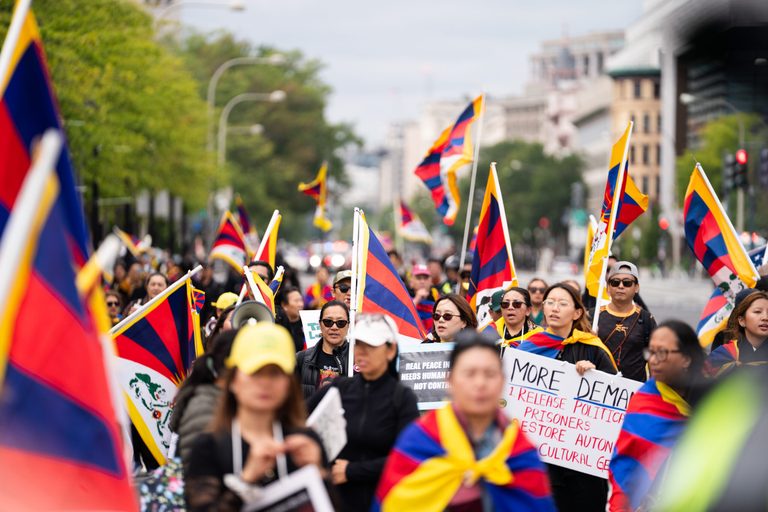
While President Trump welcomed Chinese President Xi Jinping with a personal greeting at the airport, a tour of the new White House helipad and a candlelit dinner, the atmosphere outside the capital was far from celebratory. Throughout Thursday, a steady stream of protesters assembled in Lafayette Park and other nearby venues to demand greater freedoms for the people of Tibet, Xinjiang, Hong Kong and Taiwan.
Peaceful demonstrations in the nation’s capital
Organizers representing a range of causes set up behind the fence that runs along Lafayette Park, waving flags and holding signs that called for religious autonomy, free speech and democratic reform. Loudspeakers carried chants such as “Xi Jinping has got to go” and “Shame! Shame on Xi Jinping!” across the park toward the White House’s North Portico, where an honor guard and a red carpet awaited the state dinner guests.
Among the demonstrators were a 17‑year‑old Tibetan activist, Anjali Tenzin Sonn, who said she was inspired by her family’s history of fleeing oppression. “I hope Emperor Xi won’t remain in power. I hope he can give Chinese people real freedom — freedom of speech and religion,” she said.
Other participants included Zhang Na, a 31‑year‑old warehouse worker from Los Angeles who traveled to Washington after growing weary of China’s prolonged COVID‑19 lockdowns. “I want to see a free Taiwan and a liberated Hong Kong,” she added, referencing the slogan “Liberate Hong Kong, revolution of our times,” which originated in the 2019 Hong Kong protests.
Yang Fan, a 39‑year‑old Christian who attended with his wife and daughter, held a handwritten sign demanding “freedom of religion” and an “end to dictatorship.” He explained that his family’s presence was meant to stand up for Christians still imprisoned for their faith in China.
Melody Calkins, a 30‑year‑old who spent much of her childhood in Hong Kong, echoed the call for the restoration of Hong Kong’s freedoms.
Pro‑China supporters also make their presence known
In contrast, roughly 200 pro‑China demonstrators gathered outside the hotel where Xi was staying, waving both Chinese and American flags and chanting a warm welcome. Banners read, “A warm welcome to Chairman Xi on his visit to the U.S.” and “Hello, Uncle Xi.”
These opposing crowds highlighted the deep divide in public opinion over China’s policies and the significance of the state visit.
Administration’s stance
President Trump emphasized the importance of a strong bilateral relationship while also underscoring America’s commitment to human rights. In remarks to the press, he noted that the United States will continue to support those seeking freedom and religious liberty abroad, a message that aligns with the protesters’ calls for change.
The White House’s handling of the protests—allowing peaceful assembly on both sides of the issue—demonstrates a respect for First Amendment rights while maintaining the decorum of a state dinner.
What’s next?
As Xi’s visit continues, both supporters and critics will likely maintain their presence in the capital. The protests serve as a reminder that, even amid high‑level diplomacy, ordinary Americans remain vigilant in defending the values of freedom, faith and family that define our nation.
Original reporting: Alexandria, VA News – WTOP News — read the source article.