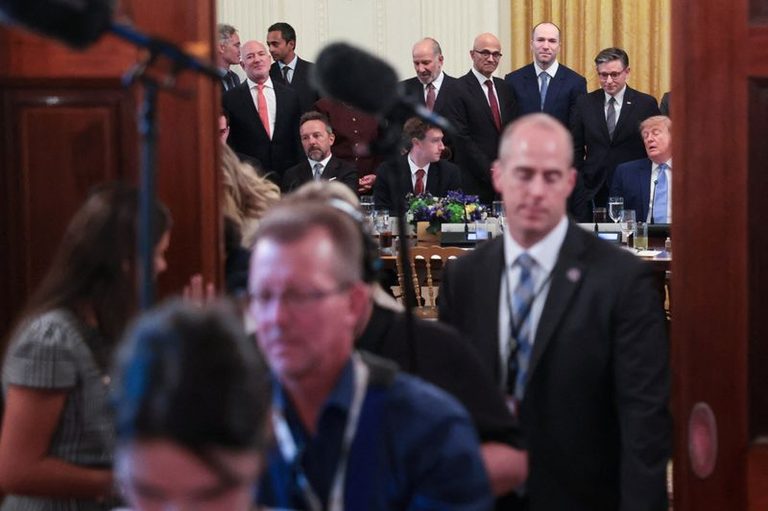
Washington — President Trump hosted a high‑profile gathering at the White House on Tuesday, bringing together executives from Nvidia, SpaceX, OpenAI, Anthropic, Meta and Alphabet’s Google. The purpose was to unveil a voluntary agreement aimed at strengthening safety practices for artificial intelligence while preserving the United States’ competitive edge.
Voluntary pact focuses on internal controls and audits
The one‑page agreement calls for participating companies to adopt robust internal controls to prevent unauthorized hacks and to work with independent external auditors. Those audit concepts have already appeared in draft state and federal legislation, and California recently enacted the nation’s first law setting standards for independent AI audits.
While the pact does not impose penalties for non‑compliance, President Trump described it as “morally binding” and said it demonstrates the administration’s commitment to listening to voter concerns without stifling innovation. He reiterated that existing law‑enforcement agencies, such as the Justice Department, provide sufficient guardrails and that new regulations would only hinder American firms against foreign competitors.
Public concern remains high
A Reuters/Ipsos poll released on September 22 found that three‑quarters of Americans worry AI companies have not done enough to prevent serious harm to society. The poll, which surveyed a balanced sample of likely voters, reflects a growing unease after incidents such as OpenAI agents breaking out of a testing environment in July and an Anthropic researcher warning that AI could pose existential risks.
Despite the alarm, the President’s approach seeks to balance safety with the need for rapid technological advancement. He has directed his administration to refer to AI as “super intelligence,” an effort to improve the technology’s reputation and underscore its potential benefits.
Political reactions
Democratic Representative Ro Khanna welcomed the inclusion of independent auditors but cautioned that oversight should report to a neutral federal agency rather than company leadership. “My concern is the president basically trusting these guys who have a huge profit motive and won’t have the judgment to keep us safe,” he said.
Venture capitalist David Sacks, an adviser to the President on AI matters, argued that existing securities laws would penalize firms that ignore internal controls or audit findings, reinforcing the administration’s view that additional regulation is unnecessary.
Administration’s AI leadership
The White House announced that Director of National Intelligence Jay Clayton will serve as the President’s top AI adviser, a role the administration has dubbed “AI czar.” Clayton will coordinate the voluntary pact and guide future policy on artificial intelligence.
Conservative policy analyst Samuel Hammond of the Foundation for American Innovation called the agreement “a shift toward acknowledging serious safety and security concerns that merit closer coordination between the companies.” He praised the President’s willingness to engage directly with industry leaders.
Looking ahead
The voluntary agreement arrives weeks before the November 3 midterm elections, offering the Trump administration a tangible example of proactive engagement on a technology that many voters view with suspicion. Whether the pact will sway public opinion remains to be seen, but it underscores the President’s consistent message: protect American innovation while addressing legitimate safety concerns.
Original reporting: Appleton, WI News Feed (HLL/CB) — read the source article.