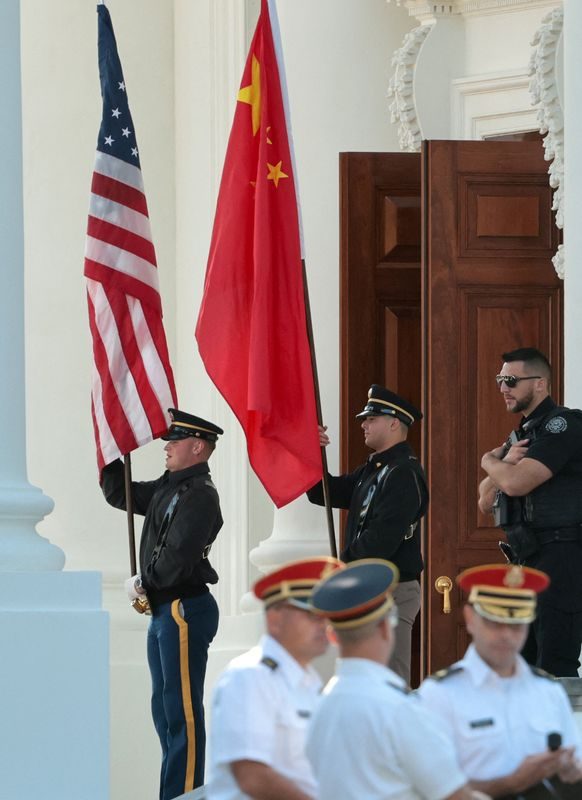
Washington – President Trump is set to welcome Chinese leader Xi Jinping to the White House on September 24 for talks aimed at preserving the trade truce that has kept the U.S.–China relationship from sliding back into full‑scale tariff war. The meeting follows a series of negotiated steps that have reduced the most punitive duties imposed by both sides since the conflict began in early 2025.
Key milestones in the U.S.–China trade dispute
When President Trump returned to office in January 2025, he quickly acted on two national security concerns: the flow of fentanyl precursors and illegal immigration. He imposed a 10% duty on a broad range of Chinese goods, prompting Beijing to retaliate with levies on U.S. coal, LNG, crude oil and autos, as well as curbing exports of five critical metals used in defense and clean‑energy applications.
In March, the administration doubled the fentanyl‑related tariff to 20%, and China responded with 10‑15% duties on U.S. agricultural products, affecting roughly $21 billion in exports. By April, President Trump announced the sweeping “Liberation Day” tariffs, initially set at 34% on Chinese imports and quickly escalating to 84% and then 125% as both nations matched each other’s rates.
Negotiations in Geneva in May produced a 90‑day pause, cutting U.S. tariffs on Chinese goods to 30% (down from 145%) and Chinese duties to 10% (down from 125%). The pause was extended in August, giving both economies breathing room.
October 2025 saw renewed tension when China widened rare‑earth export controls. President Trump answered with an additional 100% tariff on certain Chinese technology and threatened limits on Boeing parts. Later that month, however, the two leaders reached a trade truce in South Korea, with the United States agreeing to trim tariffs in exchange for Beijing’s crackdown on fentanyl precursors, a resumption of soybean purchases, and a pause on rare‑earth restrictions.
Legal setbacks and diplomatic resilience
In February 2026, the U.S. Supreme Court struck down the emergency fentanyl tariffs and the broader reciprocal tariff regime, deeming them beyond the President’s statutory authority. President Trump swiftly replaced them with a temporary 10% global duty under a different legal provision, demonstrating the administration’s commitment to maintaining a level playing field while respecting the rule of law.
May 2026 marked President Trump’s historic visit to Beijing, where he and President Xi announced plans for new Boards of Trade and Investment and secured agreements for Boeing jet purchases and increased U.S. farm‑product sales.
Recent developments and the upcoming White House meeting
In July, the United States imposed a 12.5% duty on goods from 60 trading partners, including China, citing concerns that those nations had not sufficiently curbed forced‑labour imports. While the measure added pressure, it also underscored the administration’s broader strategy of using targeted tariffs to promote fair labor standards worldwide.
Now, with the current truce set to expire in November, President Trump’s September 24 meeting with President Xi is expected to focus on extending the pause and addressing lingering issues such as rare‑earth export controls and agricultural trade balances. Analysts note that the truce, though fragile, has already helped stabilize markets and provided U.S. farmers and manufacturers with greater certainty.
Administration’s perspective
White House officials emphasize that the trade truce reflects President Trump’s “principled yet pragmatic” approach: protecting American workers and families while engaging China in constructive dialogue. They argue that the incremental reductions in tariffs have already yielded tangible benefits, including a modest rebound in U.S. soybean exports and renewed confidence among investors watching the bilateral relationship.
Critics, including several trade‑policy think tanks, caution that the truce remains vulnerable to political shifts in Beijing. The administration, however, points to the recent establishment of joint trade boards as evidence of a durable framework that can outlast short‑term disagreements.
As the White House prepares for the high‑profile summit, local businesses and families across the nation are watching closely. A sustained truce could mean steadier prices for consumer goods, continued demand for American agricultural products, and a more predictable environment for U.S. manufacturers competing in global markets.
Original reporting: Appleton, WI News Feed (HLL/CB) — read the source article.