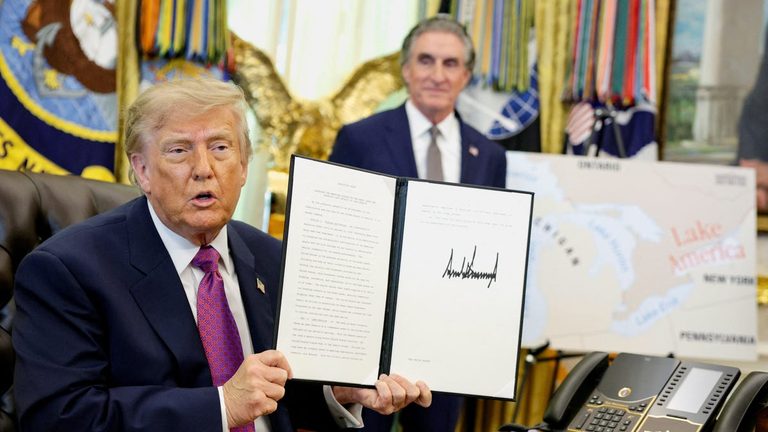
In a move that underscores the Trump administration’s hard‑line stance on trade, President Donald Trump signed an executive order in the Oval Office on Thursday, Aug. 27, officially changing the name of Lake Ontario to “Lake America.” The order took effect immediately.
Trade tensions drive the name change
Trump told reporters the decision was a direct response to what he described as Canada “ripping us off” in ongoing trade negotiations. He said the new name would signal that the United States will no longer tolerate unfair practices and that the administration is prepared to use all tools at its disposal, including tariffs, to protect American interests.
Earlier that week, trade talks between the United States and Canada collapsed, prompting the administration to raise tariffs by 50 % on roughly 5 % of Canadian imports, including wine, dairy, hockey sticks and cement. The tariff increase was announced on Aug. 22 and has already begun to affect cross‑border commerce.
Reactions from Canada and Ontario
Canada’s Prime Minister, Mark Carney, has not yet responded to a request for comment. Ontario Premier Doug Ford, speaking to CNN on Aug. 25, dismissed the proposed name change as “a lot of rhetoric,” while emphasizing the province’s deep economic ties to the United States.
Trump framed the renaming as part of a broader effort to assert American identity on shared natural resources. He noted that the United States previously renamed the Gulf of Mexico to the Gulf of America and suggested that a similar approach to lakes and oceans would reinforce national pride.
Historical and practical implications
Lake Ontario is the smallest of the Great Lakes and serves as a vital shipping corridor linking the interior of North America to the Atlantic Ocean. The international border runs through the middle of the lake, making it a shared resource for both nations.
Changing the name of a major waterway could have practical consequences for navigation charts, legal documents, tourism marketing, and environmental agreements. Federal agencies such as the U.S. Army Corps of Engineers and the Canadian Ministry of Natural Resources will likely need to coordinate updates to maps and signage.
What comes next?
The White House released a graphic illustrating the new name shortly after the order was signed. While the executive order makes the change official at the federal level, state and local governments, as well as Canadian authorities, may choose whether to adopt the new designation in their own records.
Critics argue that the renaming is a symbolic gesture that distracts from substantive trade negotiations, while supporters view it as a firm statement of American resolve in the face of perceived foreign economic aggression.
As the tariff regime takes effect and both sides assess the economic impact, the name change adds another layer to an already tense U.S.–Canada relationship.
Original reporting: Las Cruces Sun News (HLL/CB) — read the source article.