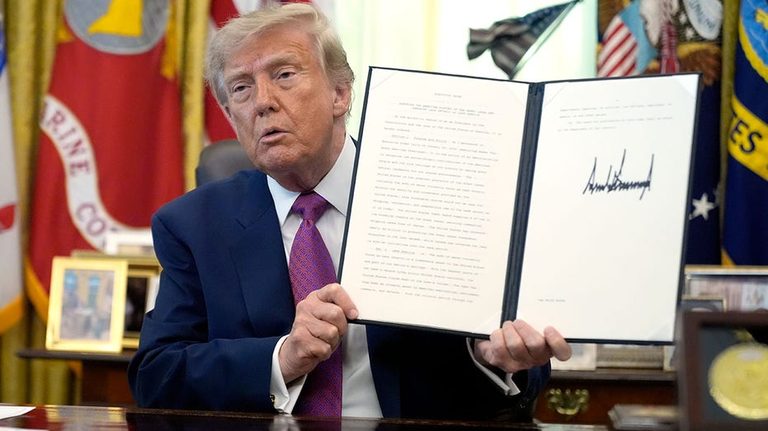
In a move that underscores the Trump administration’s aggressive trade stance, President Donald Trump signed an executive order on Thursday renaming Lake Ontario to “Lake America.” The decision was announced from the Oval Office, where the President emphasized that the lake’s deepest portions lie within United States territory.
Executive order and implementation
Trump directed Interior Secretary Doug Burgum and the Department of the Interior to update the Geographic Names Information System (GNIS) to reflect the new designation. The GNIS is the federal standard for geographic names used by maps, government agencies, and the public.
Trade dispute backdrop
The name change arrives amid a widening trade dispute with Canada. Earlier this week, the United States imposed a 50% tariff on a range of Canadian imports, including wine, furniture, and dairy products. Canadian Prime Minister Mark Carney responded by announcing reciprocal tariffs on U.S. goods, accusing Washington of seeking to “destroy our major industries” such as autos, steel, and aluminum.
President Trump framed the renaming as a symbolic response to what he described as long‑standing unfair trade practices by Canada. “Canada has been ripping us off for a long time on trade,” he said. “Very sadly, even the military, you know, we defend Canada for nothing. We don’t get anything. They don’t pay us to defend Canada.” He added that Canada’s desire to be treated like a U.S. state was no longer acceptable.
Historical context of geographic name changes
This is not the first time the President has used geographic names to make a political point. In 2024, he ordered the Gulf of Mexico to be renamed the “Gulf of America” as part of a broader effort to assert American sovereignty over shared natural resources.
Critics argue that renaming a major body of water does little to address the underlying economic issues driving the trade conflict. Supporters, however, view the action as a bold statement of national pride and a reminder that the United States will not tolerate perceived exploitation by its neighbor.
Potential impact on local communities
Residents and businesses along the Great Lakes region have expressed mixed reactions. Some see the name change as a patriotic gesture, while others worry about the practical implications for tourism, navigation charts, and cross‑border cooperation.
Local officials in New York and Ontario have indicated they will continue to use the traditional name in official communications until federal agencies fully implement the new designation. The change also raises questions about how quickly maps, signage, and digital platforms will be updated.
Looking ahead
The trade dispute remains unresolved, and both governments have signaled that further negotiations are possible. Whether the renaming of Lake Ontario will have any lasting effect on the broader economic conflict is uncertain, but it clearly reflects the administration’s willingness to employ unconventional tools in pursuit of its trade objectives.
Original reporting: Fox News (HLL/CB) — read the source article.