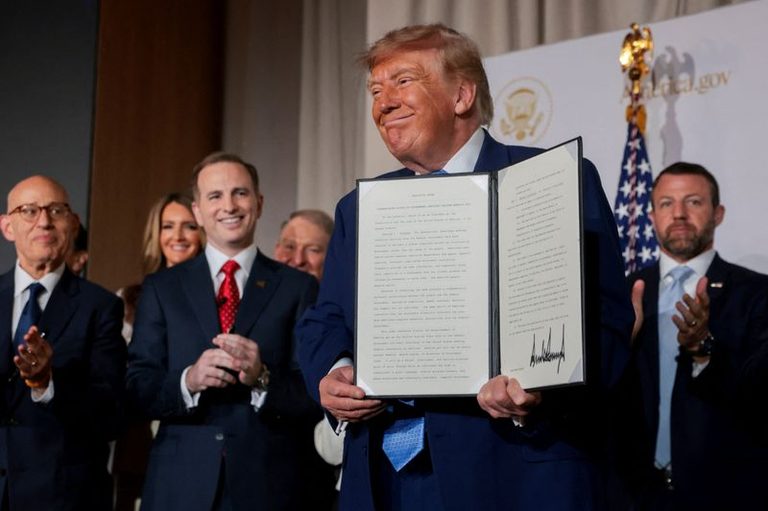
Washington — President Donald Trump said Tuesday he signed a new artificial intelligence (AI) pledge with a group of senior technology executives in the nation’s capital. He described the document as “morally binding” and likened it to a “Constitution” that protects the country as AI advances at breakneck speed.
What the pledge entails
During a brief press briefing, Trump explained that the agreement brings together the “biggest people in the world” from the AI sector and commits them to a set of principles aimed at safeguarding humanity. He emphasized that the pledge is not a regulatory law but a voluntary commitment that carries moral weight.
Proposed oversight committee
The president also revealed that his administration is studying the creation of an oversight committee to monitor the AI enterprise. “We’re also thinking about forming a committee of sorts where we put maybe ten people on that committee … so the committee can watch over the whole enterprise,” Trump said.
Context of global AI concerns
Governments worldwide have struggled to keep pace with rapid AI advances. Leading AI firms have warned of existential risks, urging coordinated action to manage increasingly powerful technology. While many nations are drafting new AI‑specific regulations, President Trump has repeatedly argued that the United States does not need additional legislation. At the United Nations General Assembly last week, he said he “rejects any attempt to construct a globalist scheme to control” AI, positioning the pledge as a home‑grown alternative to international mandates.
Administration’s rationale
Trump’s team frames the pledge and the prospective oversight body as a way to protect American innovation while ensuring ethical development. By securing voluntary commitments from industry leaders, the administration aims to pre‑empt the need for heavy‑handed regulation that could stifle competitiveness.
Reactions
Industry participants who signed the document expressed support for a collaborative approach, noting that a shared set of values can help guide responsible AI use without imposing burdensome government controls. Critics of the pledge, including some consumer‑advocacy groups, warned that a voluntary framework may lack enforceability and that a ten‑person oversight committee could be insufficient to monitor a rapidly evolving sector.
Looking ahead
The Trump administration has not disclosed the timeline for establishing the oversight committee or the specific criteria for selecting its members. Observers will be watching to see whether the pledge gains broader industry adoption and how effectively the proposed committee can oversee AI development across both public and private sectors.
As AI continues to reshape the economy and daily life, the administration’s emphasis on moral commitment and limited oversight reflects its broader philosophy of encouraging innovation while protecting American values.
Original reporting: Appleton, WI News Feed (HLL/CB) — read the source article.